
The Lost Human
AI is the problem, but not how you think.

I recently attended a symposium which addressed the popular fear that advanced AI will destroy our humanity. Whether the specifics concern humans becoming robots or wholesale species destruction, this age-old worry stays endlessly contemporary. You can learn much from each incarnation of this fear. Including how we may really be changed and die.
Historical myths such as the Tower of Babel or the gift of fire Prometheus brought to mankind illustrated people’s sense of their decline from a previous idyllic state to their present woe.1 Plato worried that writing would diminish our ability to remember, and thereby diminish us. Goethe drew on the historical figure Faust, an alchemist and proto-scientist, to create a literary figure who loses his soul in his quest for ultimate knowledge. In different ways Karl Marx, Sigmund Freud, and Charlie Chaplin riffed on how modern mechanistic society changed and diminished human beings.

And yet, here we are, human enough in spite of it all. Yet also different from the pre-Socratics, medieval alchemists, and grumpy 19th century Germans. Different, and yet still human. Which might lead one to respond to the “Tech will dehumanize us!” concerns with, “of course it will - it’ll make us into another version of humans, which isn’t the same as who we are today.”
Change has always been a problem. Over time our responses have changed, from the “don’t go there!” of Babel and Plato to the “here’s how to adjust to it” of Freud and Marx.
Today we’ve largely capitulated to the reality of change, and we discuss adjustment to AI in terms of aligning our interests, of co-evolving for mutual benefit.
At the symposium one man said humans and machines were hybridizing. People are now like centaurs; their humanity is sustained by machine intelligence. AI, meantime, is like a minotaur; its machine essence is increasingly taking on human characteristics. Soon the human centaur and the AI minotaur must integrate. A woman spoke of designing AI systems after biological systems of cooperation, aligning the needs of humans and machines.
Both evoked the creation of mitochondria 1.8 billion years ago, when an early cell engulfed a bacterium. Mitochondria created a more capable entity, eventually resulting in our rich and complex multicellular world.

It’s dramatic to align the present moment with the most consequential development in the history of life. While it’s a compelling metaphor, though, what does “co-evolution” mean? In cooperation, both sides have needs they seek to satisfy. But what are the needs of a bunch of software? Does a Customer Relationship Management software application “need” to file all the current hot prospects? Why and how will AI evolve needs?
For all the formidable brainpower going at this human/machine problem, I suspect we too often fall into the trap of taking the conversational interface of AI as evidence of its evolving intelligence. It talks to us, so it must think. Recently even the eminent Richard Dawkins, author of The Selfish Gene and much besides, fell into just such an error.
Initially it seems forgivable. The computer interfaces we’ve evolved over the past few decades have become increasingly captivating. Why else would people scroll on their screens for hours? No blame there.
AI has been deliberately engineered over time to increase human engagement. That’s why almost every answer you get from it tells you how brilliant you are, or why the chatbot relies on the language of support and continuation. Flattery keeps you talking to it. This design comes out of a technical culture that largely sustained itself and grew with advertising, in which more time spent online was always better.2
We do not have conversations with AI in a human sense, with authentic emotion, challenge, a feeling of mutual enthusiasm or conflict that moves us. Genuine human interaction includes things that are difficult, that often challenge our personal vulnerabilities, and that ultimately make us more empathetic. Which is to say, more human, and more willing to be with other humans.
On the other hand, the social and mechanical tweaks that have made the interface so seductive, to a point where people would rather scroll on an increasingly AI-driven phone, or engage with a chatbot instead of another person, are now proving more dehumanizing, and possibly more of an existential threat than anything that could come from an autonomous foreign intelligence.
The Financial Times recently ran an article on the shocking global drop in fertility rates (article here, my visit to the childless world here.) It included a single chart that should bring us all up short: a graphic of what happened to the fertility rate in a diverse range of countries3 after smartphones became popular:
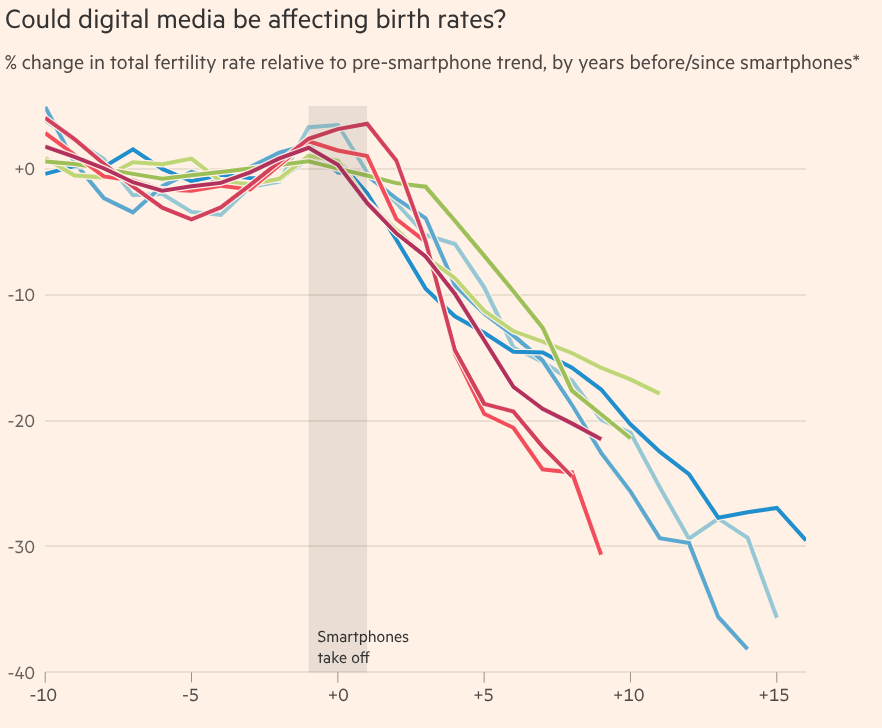
There is no co-evolution here. Just fewer humans, talking endlessly to themselves.
It’s a great story that says much about technology and people, but the short version is that after Prometheus stole fire from the gods and gave it to humankind, he was chained to a rock and tortured. His brother and unwitting co-conspirator, Epimetheus, married Pandora, to whom the gods gave a wedding jar, telling her not to open it. As anyone would, she opened it. Out flew all of mankind’s woes, leaving behind only Hope. It’s not clear whether this was the gods’ act of compassion to humankind, or their final boot in our collective face.
Though almost all products are designed to maximize their own consumption: In my youth they even tried to increase consumption of the soda pop Dr. Pepper by pitching it as a hot beverage.
United States, Australia, Egypt, Indonesia, Iran, Senegal, the UK.
Another thought instilling essay! Never knew about the hot Dr Pepper marketing. I met someone from the south at our alma mater who regularly had a case of Dr Pepper shipped to her.
“ I suspect we too often fall into the trap of taking the conversational interface of AI as evidence of its evolving intelligence.”
Indeed. AI can keep trying. Those of us that can think critically, reason critically, and write clearly will certainly keep reminding everyone that it’s just a cleverly engineered conversational tool.