
Simply, Slowly, Light.
Watching a genius struggle with the unnoticed obvious.

Patient simplicity is an uncommon act of will. Critical in achieving meaning, it’s becoming harder. That’s a loss, because striving for simplicity, or even simply witnessing it, is among the most valuable things we can do.
Paying attention has always been hard, but contemporary technology is certainly the enemy of patience. Today’s world is replete with additional information shrieking for consumption. Big parts of our economy are based on judging stuff, quick, from the moment we open our eyes and reach for our phones.

Over centuries, the art of asking simple questions and staying with them patiently has been the engine of great creative achievements. Newton observed an apple falling in his garden and thought about what pulls things down. Why does the Moon not fall on the Earth? Over several years he proved mathematically that the moon would fall, but gravity pulls it at an angle, and its fall becomes rotation. Einstein wondered what it would mean to ride on a beam of light; after decades pondering this simple question he elucidated the theory of relativity. For Darwin, the question that puzzled him for decades was why children are always different from their parents.
In art, Vladimir Nabokov read about a chimp in a zoo who was given a pen and pad and drew its bars. After a couple of decades of thinking about what it means to draw your imprisonment, he published Lolita. Coleridge supposedly dashed off “Kubla Khan” after reading a single line in a travel book, but he revised the work for another 19 years. On a slightly different note, Umberto Eco wrote that he conceived of The Name of the Rose because “I felt like poisoning a monk.” He added, “I believe a novel is always born of an idea like this: the rest is flesh that is added along the way.”
Here is a recipe for greatness: Think of a big simple question, the kind of thing a child might ask. Take it so seriously that you hammer on it for years.1 It’s probably harder now to think for a long time about a simple question, given our perpetually online fragmented selves, but that doesn’t mean the formula has changed. It means we have to work harder at it.
One way we non geniuses can do that is to concentrate for a long time on a genius who is struggling with a simple question. In a sense, that is doubling down on paying attention, or paying homage to concentration itself. Not to mention, paying attention to something, long and hard, is almost inimical to staying pointlessly angry, our society’s sadly abundant sentiment.

Starting is as simple as finding something that moves you and wondering, What might be the simple question inside it?
During September I stared hard at a single painting for a couple of hours over ten or more occasions.2 I thought a lot about the way the painter seemed to be thinking about light: What is it? Why is it here? What does it mean? I wasn’t engaged in the determined pleasure of scientific or artistic discovery, but, the next best thing, I was appreciating a genius engaged with a big simple question, on his own terms.
If it’s presumptuous to assume knowledge of undisclosed thoughts, so be it. Worse, the genius in question lived almost six centuries ago, in a mental landscape no one today can fully understand. He was Piero della Francesca. I’ve written about his work before, in the context of how art generated science through new ways of analyzing the world. Far removed from our times, he thought about light very differently than we do now,3 but in some ways that made my sympathetic contemplation (imagination and conjecture, followed by more viewing) more enjoyable.
Full disclosure: despite revisiting Piero here, I’m not really a fan of his work. His people have too much cold emotional distance. Nonetheless, I do return to him. Over my month with this painting4 and a few more of his works, I was warmly attracted to how hard and successfully he thought about light, that essential and omnipresent aspect of life.
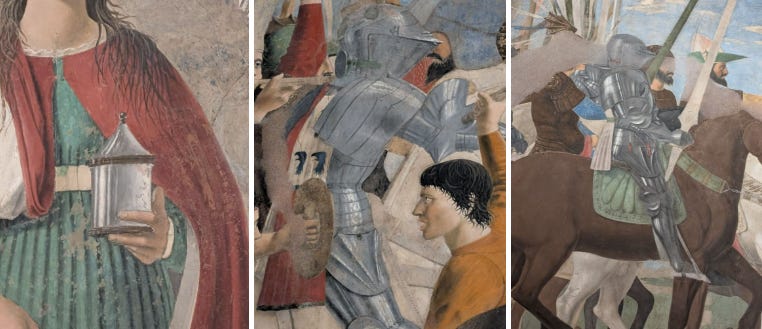
Take these images of reflected light from three frescoes, located in two churches in the city of Arezzo. The light reflected on the crystal jar, and on the two sets of armor, is an accurate representation of the way the light which comes from the churches’ main windows hits the walls on which the frescoes were painted. The technique is particularly powerful in the two battle scenes, which face each other within a larger cycle of paintings.5 The knight on the right, reflecting the light in various ways from the top to the bottom of his armor, is particularly striking. You are seeing a mathematician/artist asking himself about light, and working out theories of three-dimensional light on two-dimensional surfaces, while unifying this in an image of art, religion, and folk history, 560 years ago. Not bad!
The painting and the light I (ahem) reflected on most is this one, executed soon after Piero finished the enormous fresco cycle with the two battles:
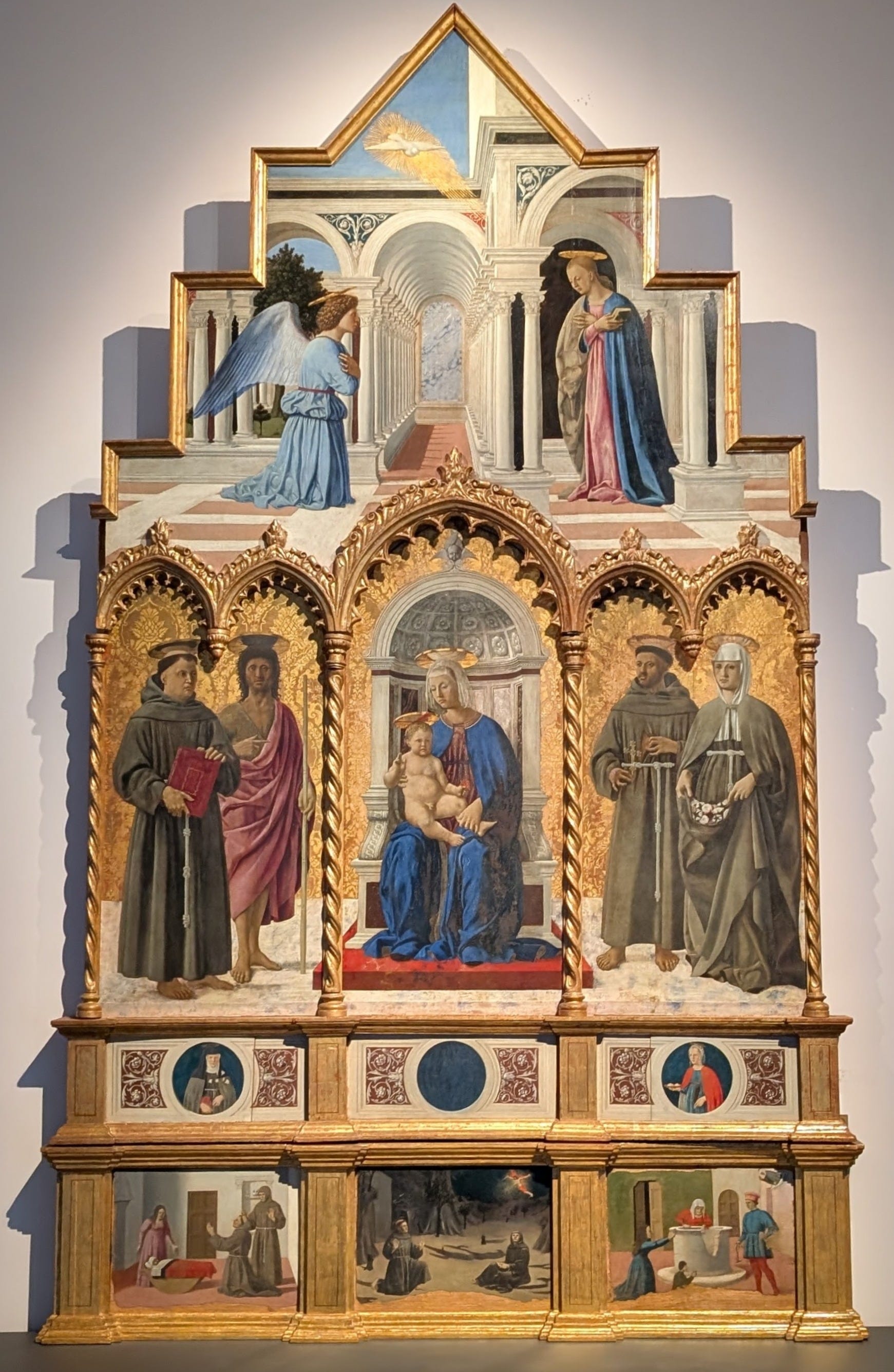
Piero, who illustrated manuscripts of Archimedes’ work early in his career, was one of the first great masters of mathematics in art. This being the 15th century, everything he was discovering was shot through with his conception of God. That’s why the baby Jesus here aligns with both the temporal niche where he sits with his mother, and with the receding portal to eternity above him, where God descends to both announce and impregnate the Virgin Mother. The human and divine in one occupies perspective in both regions.
Over repeated visits I began to notice the light in his work, and to appreciate how much Piero was thinking about this strange, insubstantial, and essential thing. For example, he painted reflections of everybody’s heads in their halos, with an almost unnerving accuracy.
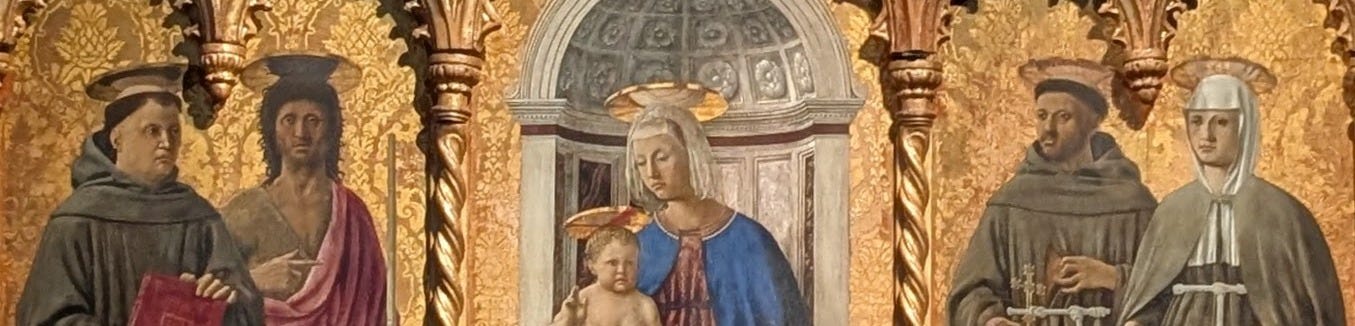
Those reflections are from the light on Earth. Even if these long-dead saints wear marks of eternity, they persist on our mortal plane, where light reflects imperfectly, has shadows, and otherwise exists within our limited perceptions.
Above, though, we see an expression of light in the presence of God:
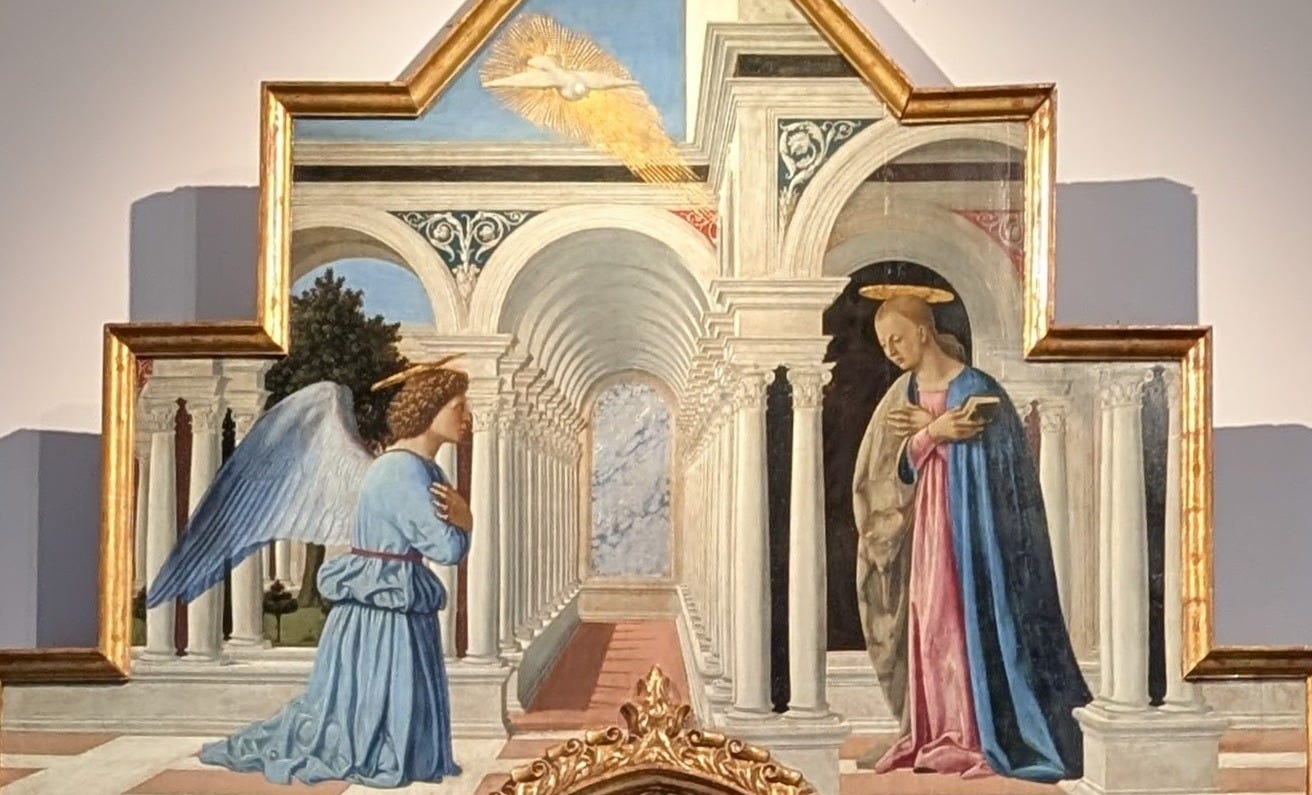
I must have stared at the painting a half-dozen times before I noticed the shadows and their absence. Piero painted a strong shadow along the receding arcade, so the sun is coming down strongly from the upper left. The representation of God, in the dove and the golden light that will touch Mary, comes from the same direction. But in the foreground where the dove appears, no shadows are cast anywhere, not on Mary, nor the angel, nor even the pillar. Under the divine light, there is no direction; everything is infused with light, so there is no shadow anywhere, just as time disappears in eternity.
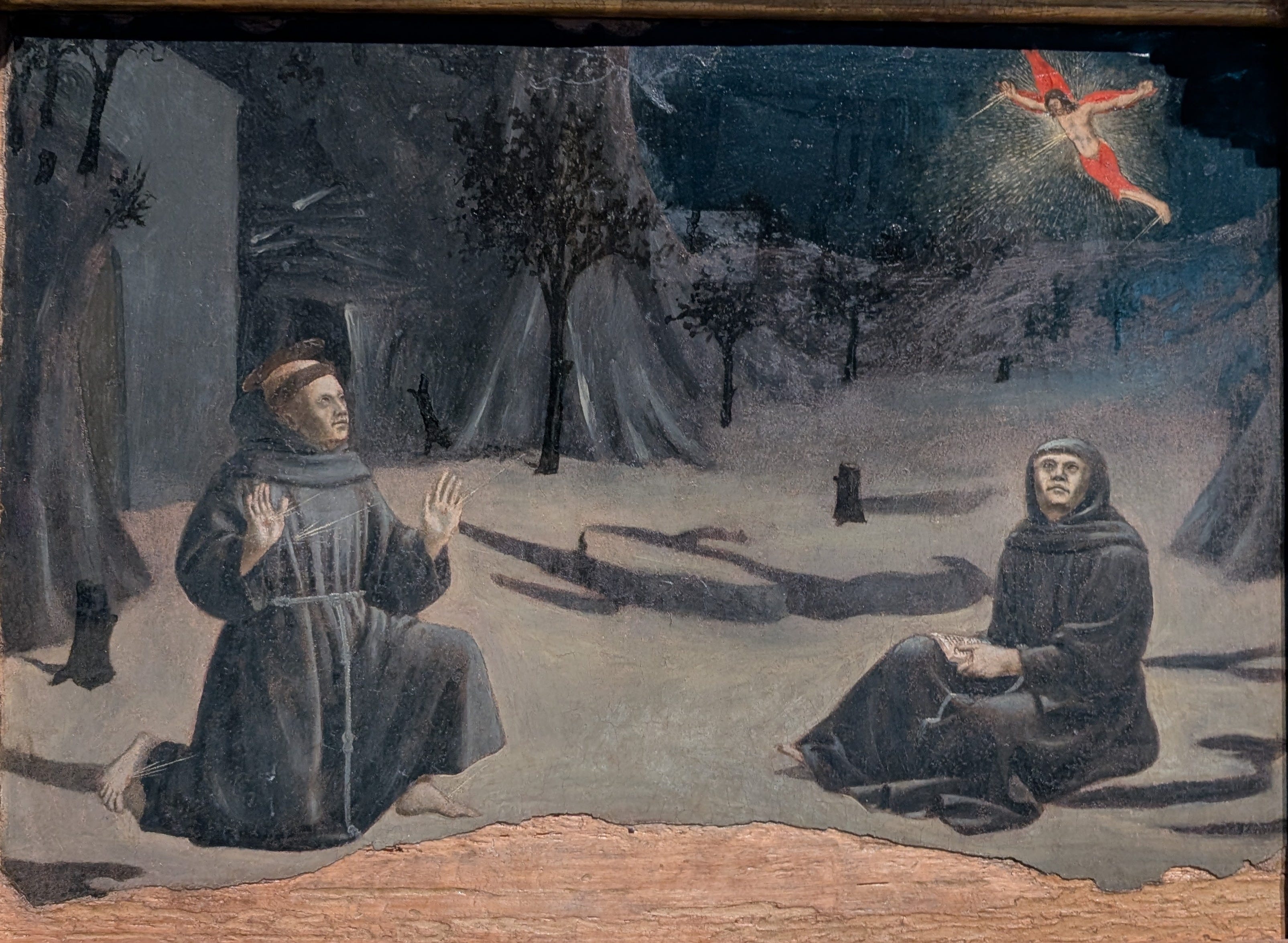
It’s the same at the bottom of the painting, where Saint Francis is receiving stigmata: In perhaps the first ever painting of nighttime, the Christian God is the illumination, and there are no shadows thrown by this source of light. It is eternal and omnipresent.
I believe that was his simple question: What is light, anyway? And subsequently, where does it live? Is there something beyond its manifestation? How would light be different in Heaven?
I’m a confirmed agnostic, and I’m certainly not trying to sell anyone on conversion to a medieval Christian conception. The eternal, here, results from someone who wondered deeply about light, and then worked on portraying it over decades. Just intimating his engagement with the question of light was intellectually enriching, and more profoundly it revealed the humanity of his own long, slow process.
Paintings aren’t supposed to come with full explanations, as any art historian with a soul should freely admit. All the best talk is in the interest of adding depth. So my point about light should not stand as a decisive explanation, as much as an element of admiration. Moreover, for all I’ve said here about sources of inspiration, I’m wary of saying what’s in another person’s head when they’re in the here and now, much less than what someone was thinking in 1466.
Unquestionably, though, the humanity of his slow process of creation has endured over time, and with patience it remains accessible. Like love itself, it is a simple idea and an endless mystery, revealed with time and attention.
The method and its difficulty hold equally for art and science. When Joseph Conrad wrote that “art is long and life is short, and success is very far off,” he was paraphrasing Hippocrates.
This was not based on Jennifer Roberts “immersive attention” exercises in looking at paintings, which I only found out about later. Can’t recommend them highly enough, though.
For an excellent talk on today’s view of “Does light matter?” check out this lecture from Britain’s Royal Institution. It’s a model of how to cover a large and complicated subject in 60 accessible minutes. Spoiler: Light is essential for the universe to exist.
I was in Perugia in September, and for 25 Euros purchased an annual pass to the museum. If you live near a decent museum, I can’t recommend an annual pass enough. It enables you to dash in and focus on a couple of things, without worrying about whether you’re getting the whole thing. If you live in New York or London, dashing in for a quick painting on your way from appointment A to obligation B is the only way to deal with a Met, or a National Gallery.
By the way, this repeated visit to the Piero isn’t to say there weren’t many other fine artworks there, each worth its own contemplation. The crucifix from 1200 that originally had movable arms for acting out the deposition from the Cross (interactivity!), the superb collection of works by local hero Perugino, and the Pinturicchio Altarpiece could each bear their own devotion.
And probably should, if only to put a thumb in the eye of contemporary tourism. I have a friend who is a guide in Perugia, extremely deep in multiple subjects. Most of the time he takes tourists to Assisi, where they want a tour of one hour, including shopping. The city of Perugia, which besides this museum has the most beautiful stained glass I’ve seen, a 13th-century fountain, Etruscan gates, and a world-class archeology collection. Many of his clients give it three hours. Honestly, what are they rushing to, that makes them miss this?
“The Legend of the True Cross” was a medieval tale of how the wood on which Jesus was crucified came from a tree that began life at the time of Adam’s death, was hidden by the Jews for many generations, recovered, and used to enable the Christian savior’s promise for man’s redemption. It doesn’t play particularly well in the modern mind. but it covers both sides and the back wall of a the church’s main chapel.
Piero didn’t paint it in a chronological order, but there is a kind of thematic symmetry in the organization. Adam is across from Jesus, a kind of Alpha and Omega; the two decisive battles flank each other; there are two facing scenes in a king’s court; two flanking announcements from Heaven; and two images where it’s bad for the Jews. Lots to study and admire. It’s a good reminder that, with all respect, medieval churches were somewhat like giant comic books that mostly illiterate people could contemplate for hours.
I always liked the idea of a big ice ceiling hanging there, waiting for rain...
I can remember being with you once in England, in Eton, I think. For some reason the subject was hail stones. And you said: "I wonder how all that ice gets up there, and how it stays there until it rains". Over the years I've thought long and hard about that, my old friend.