
“Shhhh….Golfers!”
Rearward-looking from my wayback machine, and travelling ceaselessly forward.

I might not recognize the Darien, CT, Country Club, unless I were riding in the rear-facing seat of an early nineteen-sixties station wagon. It’s the only way I saw it in my childhood, and when I try to make sense of my kid memories, that view is what I have.
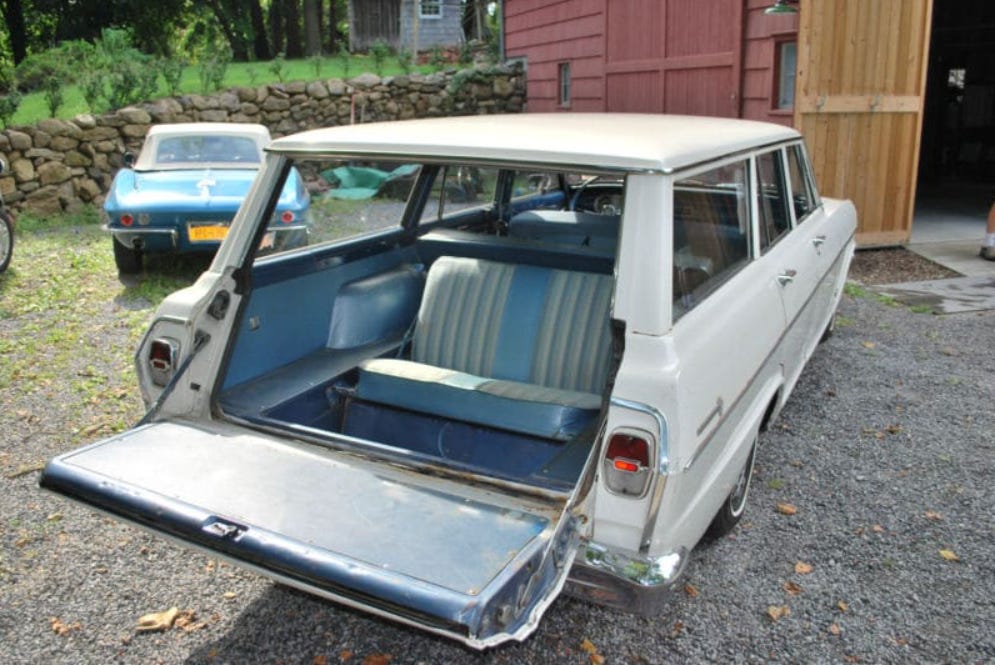
On Saturdays Mom drove to the country club to have lunch with Dad after his regular round of golf. A long driveway curved through the golf course, and as we entered Mom would quiet her five rambunctious kids by announcing, “Shhhh….Golfers!” Somehow1 it got to be a gag with us, as these things will with kids, and I can still remember us quietly cracking up, shushing each other and repeating, “Shhhh….Golfers!”
In childhood the world is always before you; you don’t have much personal history or a larger context to understand your times. My childhood happened in a superficially certain and orderly world, where Dad golfed and I got to ride in the wayback, as we called that rearward-facing bench seat, awaiting special times.
Experience and imagination put our childhood memories into new contexts. Paradoxically, while the context I might build around a childhood memory is a work of the imagination, it’s often analytically more true than the memory itself, since the original is so Quentin-centric. The same goes for you.

Which is why, for many years now, when I look back at driving past those affluent men in their foursomes on the fairways, I think of them quietly, processing their bone-deep experience of a terrible chaos. If they were lucky, they did this with three comrades who’d also lived amid the horror.
At that time World War II was as distant as the 2008 Financial Crash and the election of Barack Obama are from today. Yet while parents today might well talk to their kids about living through 9/11, or the wars in Afghanistan and Iraq, or Trump and COVID, the men on the fairways and the moms at the helm of the station wagons told us almost nothing about their experience of one of the greatest cataclysms in human history. There were the big facts and various fictional entertainments,2 but we heard little in the way of their lived experience.
The silence contrasts with the scale of that experience: Seventy million dead globally, give or take ten million people. It’s not simply that WW2 surpassed the Black Death in sheer numbers. Imagine how mad and widespread that war must have been, to yield a variance of 20 million humans in the final count. Unlike previous wars, the civilian dead outnumbered the soldiers by 2:1 or more.
In 1946 there were 30 million displaced people in Europe alone. Hundreds of thousands more were killed in the score-settling that went on for years afterwards, in places so recently the seats of high culture. The collapse of exhausted European empires led to years of killing and forced migration in India, Indochina, Algeria, and elsewhere. The economic misery was almost as staggering: in 1946, following the most ruinous inflation in history, the value of all of the currency in Hungary was worth 1/1000 of a U.S. penny.3 Soon after that there was a violent revolution in China, and a war in Korea which had its roots in 1945. There was no sense of any of this in the station wagon, unless you count the smoking.
In 1998, as the men on the golf course and the moms in the station wagons were starting to die off, they were branded The Greatest Generation, heralded as a stoic bunch who just got on with it, beating Nazis and restoring the world. While a great valediction, that feels false, and way too easy, like something nice you’d say to grandpa in his dotage. It’s also hard to buy the popular idea that the soldiers came home with their trauma fully processed, thanks to a few weeks of intimate story-sharing in the camps and troop ships before they demobilized.
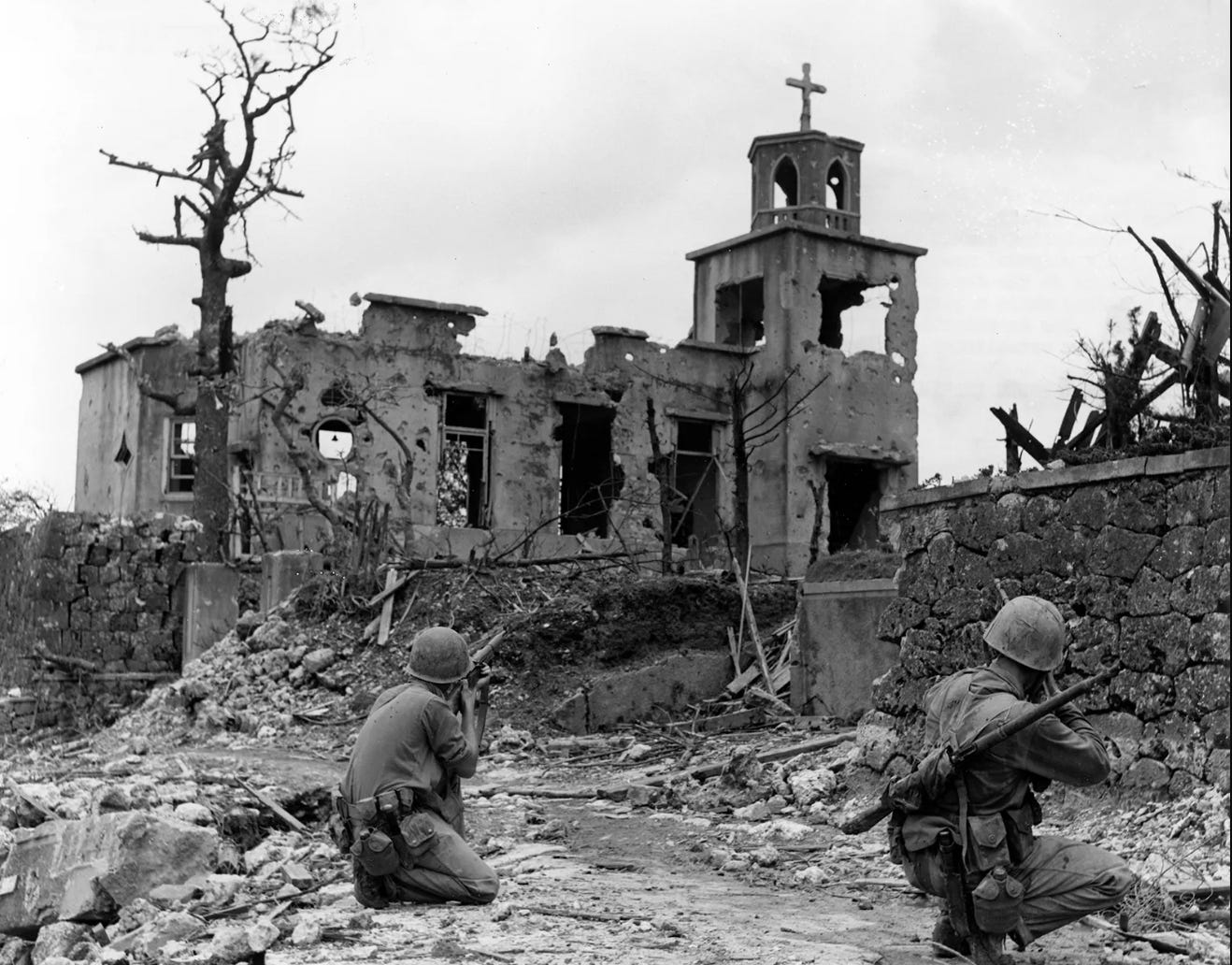
Every now and then we kids saw flashes of what was covered up. A family friend was this wonderful guy in publishing, regarded as one of the best-read people in America. He’d been at D-Day. At one holiday dinner I asked him about it and quietly he began crying. A good friend’s dad trained at Guadalcanal before seeing action in Okinawa; among his Marine platoon people wore necklaces of molars and ears (the same happened on the enemy side, and in wars since.) After the war he went to a nice college and became a successful executive, who liked to walk alone in the woods for hours at a stretch. His biggest reference to the war was his advice, “If you’re not marching, start digging.” If you can’t move forward, prepare for something bad.
Another family friend was declared mentally unfit for service and spent time in a psychiatric hospital, using his exceptional prewar artistic talent to ghost the illustrations of more famous cartoonists. A doctor drunkenly walked up to my brother and told him how he could kill him with his hands. There was another one who beat his kids. Shhhh. Golfers.
Multiply these anecdotes by the tens of thousands, and the clichéd view of the nineteen-fifties as an era of conformity feels more like an epic period of willful suppression. And the craziness of the nineteen-sixties feels like what happens when a long-held family secret erupts like a secondary volcano off its dormant core.4
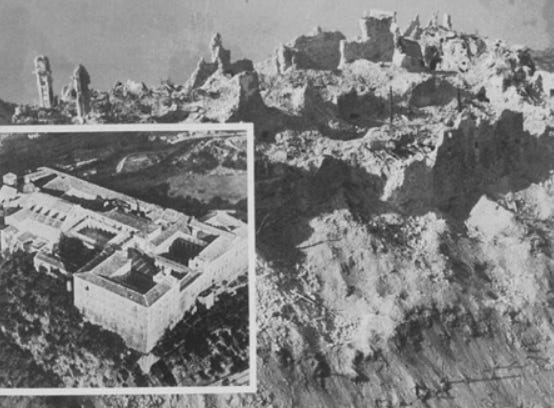
The father of another friend survived the slaughter at the Kasserine Pass, then won a Silver Star on his way to the devastation of Monte Cassino and the carnage at Anzio before he was wounded in France. He had a theory he called “Boosters.” If you had done all that killing and walked across the ruins of ancient beauty, how could a bright plastic shopping mall, all safety and prosperity, look ugly? How could you not be a booster?5
The foursomes on the fairway were survivors, and I wonder what they worked out collectively, talking about the game, enjoying the beauty and the safety, seeing their intact families driving up, the children gleeful in their conspiratorial silence. Shhhh….Golfers. The car drove ahead as we looked out the rear; we watched the greens recede, and we arrived.
But where? Sometimes I look into deeper history for clues. After the cataclysm of the Black Death, Europe was irrevocably changed. Newly mistrustful of the Church and the rulers who were unable to forestall the catastrophe, a new merchant class created lines of communication between cities to arbitrage the goods of the dead and the needs of the living, in pockets where the losses weren’t as bad. Over the following decades, while the new mercantile need for knowledge, power and status drove the Renaissance, merchants also bankrolled and participated in wars across Europe.
We live among dramatic social and economic changes as great as those following the Black Death. In the U.S., WW2’s direct outcomes include the electronics industry and the engine of the Military-Industrial-Congressional Complex (as Eisenhower originally meant to call it). Worldwide, more than a hundred new nations emerged as empires gave way. Boundaries continue to shift. A post-imperial consciousness of individual liberty, abetted by technologies like birth control, media, and computers, helped create new social movements like desegregation and gay liberation.
When we shake off the contemporary mania for seeing each daily thing as overwhelmingly strange (and thanks to the need for clicks, a cataclysm), it looks like we’re really in the middle of a bigger and longer transformation than we readily acknowledge. Shhhh….Golfers.
Influenced by my mother’s pervasive irony about much of her life in the suburbs.
One of the more famous television shows about the war was called “Combat!” It ran from 1962 to 1967, longer than the U.S. involvement in World War II. During this period my parents, swamped by so many kids, hired au pairs from Ireland, England, and Germany. Looking back, at least a few of them had been little kids amid the postwar rubble, but that wasn’t talked about. My brother recalls watching “Combat!” with one of the German nannies, and her saying, “We have shows like this at home, but the Germans always win.”
This anecdote is from Tony Judt’s great “Postwar.” Everyone who wants to know where today’s world came from should read the first couple of chapters. Everyone who wants to see a model of exceptional research, too.
George Harrison had a great line explaining Beatlemania: “They used us as an excuse to go mad, the world did, and then blamed it on us.”
The incredible effects of the Marshall Plan on postwar Europe probably played a role, too. That aid, concocted when there were thousands of orphaned children wandering in the parks of Rome, and the governments of France and Germany expected it would be 25 years before they regained Depression-level wealth, was greater than all of the previous U.S. foreign aid put together. Along with industrialization and global trade, it created a recovery no one expected. Seeing the payoff from that money must have been another incredible assurance for fighting the good fight.
America benefited by coming out of the war as the least-damaged power, with labor earnings getting a bump that compared with the late 14th Century, after the plague. It’s where we got the idea that with just a high school education you could get a job that afforded two cars and a home in the suburbs. It all started to go away around 1973, as the other powers recovered, and ever since politicians have had to promise to take America back there again.
A beautiful tribute to our fathers, both on the battlefield and the greens, an elucidation of what was buried beneath their often congenial surfaces.
Really an extraordinary piece of writing, even for you. So many deep, unacknowledged wounds, in people and in nations.