

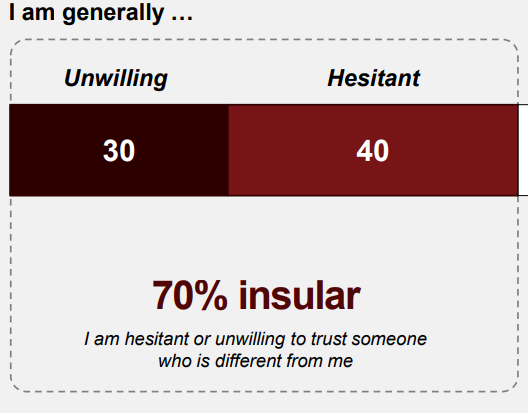
On Tuesday Edelman, the multinational PR and marketing firm, published its annual Trust Barometer, a survey of 34,000 people in 28 countries. Every year there is a central theme to its conclusions, including increasing trust of nongovernmental organizations (2001) and the fall of the celebrity CEO (2002), as well as the cycle of distrust (2022) and the polarized world (2023.) This year the theme is “Trust Amid Insularity.”
This year’s theme paired uncomfortably well with last Sunday’s post, about how algorithmic personalization had contributed heavily to a sense of isolation, both institutionally and personally. I argued that when people are bombarded with media and advertising based only on their own choices, and the viewpoints and experiences of people very much like themselves, they actually lose something of themselves. Deep down, we benefit from encountering difference; it grows us and gives us greater human connection to others.
Here’s the leading graphic in the Edelman report on Trust.
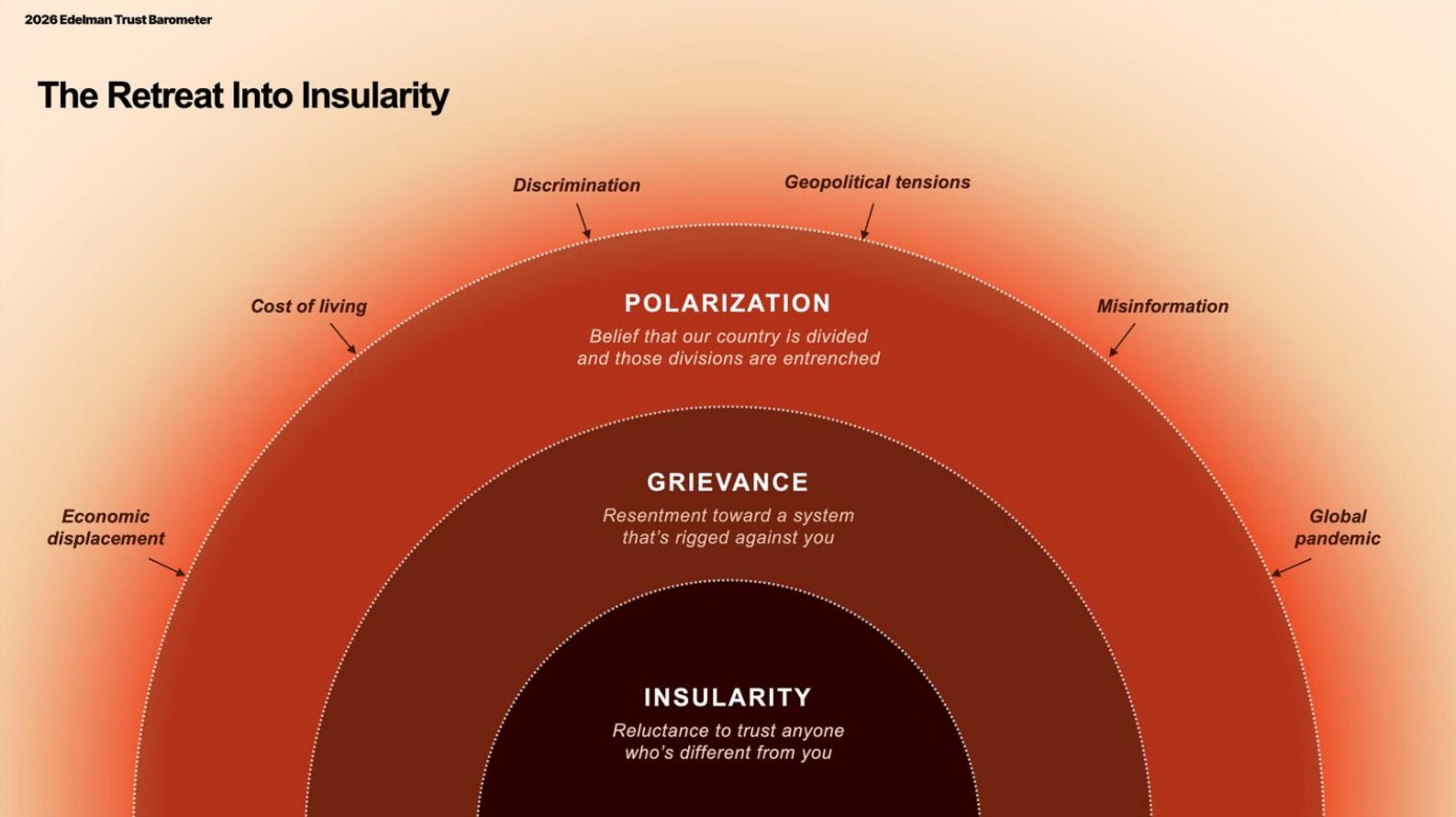
I take no joy. First Polarization, as people feel segmented within a dysfunctional system. Then Grievance, as an increasing number of people feel the larger system excludes or conspires against them. And finally Insularity, with a failure to trust everything that doesn’t resonate with their personal beliefs and biases. Or, if you prefer, media and shopping choices.
Edelman didn’t conjecture about the causes of this insularity, which it terms “the reluctance to trust anyone who is different from you.” Readers of last week’s Curiosity Shop know my guess about why, as both a local and a global culture, we’re in an epidemic of narcissistic fear.
Unfortunately for Edelman, which is a multinational company involved in cutting edge PR and Marketing, it may be difficult and painful to examine whether personalized digital PR and Marketing are the culprit. It’s unfortunate for us, too, as they are well-positioned to try and do something about it, provided they can take a hit to earnings for a while.
Despite its gloomy implication, there is some great additional material in this survey. Globally, only 39% of people get information from sources of a different political leaning from their own at least weekly, a number that has fallen by six percentage points in just a year. In 2012, there was a six percentage point gap in trust between the more trusting upper 25% in income, and the less trusting bottom 25% in income. Today that gap is 16 percentage points. That is telling information about the hardening of difference within a population that was once more unified.
Another number will jump out for those of you who read my recent piece on the near-top 14%, and their culture of peril: Upper-income Americans, more than the wealthy of any other nation, feel that they’ll be left behind by Artificial Intelligence. It’s a feeling among 47% of America’s highest-income group, while in China just 21% of people with top incomes, feel that way.
Perhaps Edelman could focus on the 85th to 99th percentiles, in particular those working in technology, my dear 14%. The fear of being abandoned might be even higher among that cohort.