

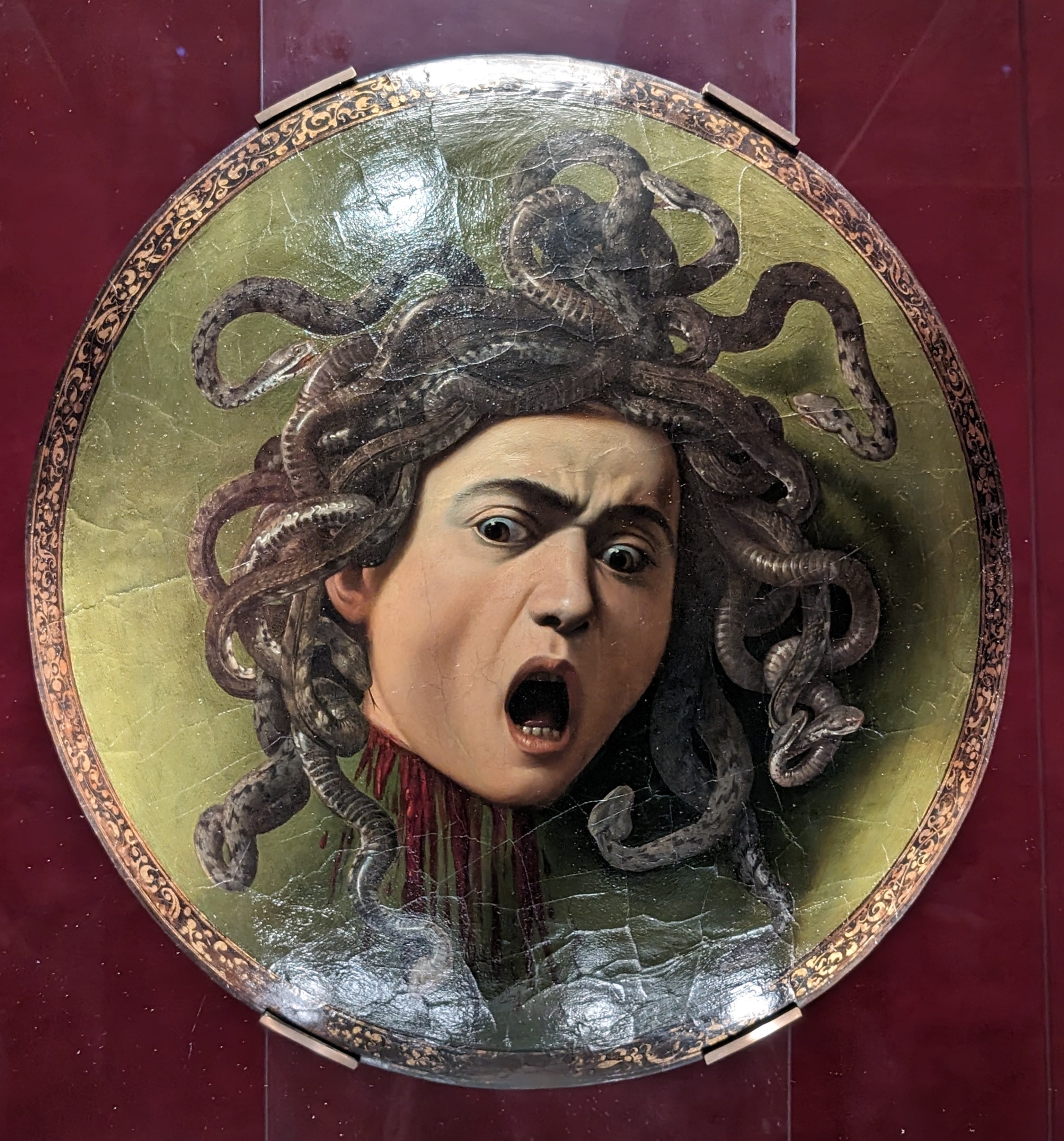
If you’ve seen this painting, you were probably exhausted. It’s in the final corridor of the Uffizi Gallery in Florence, Italy. You get there after crossing rooms containing works by Giotto, Martini, Uccello, Piero della Francesca, Botticelli (1), da Vinci, Michelangelo, Raphael, Durer, Bronzino, Titian, and Gentileschi, to name a very few of the painters (and without mentioning any of the sculptures.) I really enjoy looking at art, but even with a long lunch at the cafe, there are limits to what the eye and the legs can do.
It’s a real shame, since besides being a terrific work of art in itself, this painting does so much to reward the well-rested observer. Like much good art, anywhere, anytime, it also says much about where we are today.
As the title says, it is a painting of the head of Medusa, the snake-haired Gorgon sister whose looks turned to stone anyone who gazed upon her. The hero Perseus used the goddess Athena’s polished shield to view a reflection of Medusa while she slept, preserving himself by not looking at the Gorgon directly. He decapitated her and put the head in a sack for a while, turning to stone a few enemies and the sea monster that had captured Andromeda, his future bride. Then he gave the sack to Athena. No word on what she did with it.
The subject of this painting, though, is not exactly Medusa, as much as the recognition of inevitable death. The face belongs to Caravaggio himself. And this Medusa isn’t sleeping, she’s seeing herself in the mirror at the moment of decapitation, a very precise point of life giving way to death that isn’t recorded anywhere in the myth. As viewers, we are also seeing the reflected horror, staring at both an individual and a universal image. Death, if not decapitation, is coming for everybody. Which means we are looking into a mirror ourselves.
The painting is not simply executed on circular surface. It’s on a shield, the very object Perseus used to kill the monster. This takes us through another trapdoor of reflection and meaning; most paintings presume to be windows on a particular moment, not artifacts from the moment itself. On top of the linen covering the wood of the shield, Caravaggio laid down several preparatory layers, so the final paint became more reflective.
What we’re looking at when we stand before this is at least two, and possibly three or more, mirrors. There is Medusa realizing she will soon be dead. There is Caravaggio staring into a mirror for self-portraiture (it helps to know that mirrors were largely convex, like the shield, at this time). There is the universal shock of reflecting on mortality.
From our distance there is a mirror on Caravaggio himself, and how resonant his personality is for the artist in our time.
In our present age, when self-mythologizing and martyrdom are so often key to the biographies of successful artist, the authentic violence, suffering, and self-awareness of Caravaggio is prophetic. It may be every bit as important as his mastery of real subjects, and his exceptional work in chiaroscuro, the interplay of light and dark.
In the century preceding Caravaggio, artists had leveraged their relationship to status-conscious merchants and nobility to transform themselves from ordinary artisans to great souls whose works you had to collect. Isabella d’Este, one of the first great collectors, begged da Vinci for an artwork, it didn’t matter what. Which has worked well ever since.
Caravaggio’s self-awareness of his genius, his ego, and his self-defeating dark side, though, makes him the true avatar of the contemporary artist archetype. No wonder that, though he fell out favor soon after his death, he was rediscovered and has been revered since 1950. We now love these “outlaw genius” stories, which have often come to equal authenticity.
Unlike many contemporary artists, though, Caravaggio’s anxious mythologizing seems grounded in hard fact. He was, by all accounts, a very hard guy, as happy to be in drunken street brawls as he was to be in the service of senior members of the Church. He’d get arrested for carrying a sword, throwing artichokes at people, mouthing off to the cops. He went to public executions, and committed at least one murder, which put him on the run to the end of his days. (2)
That emotional familiarity with people in the moment when they know it’s too late, they are going to die violently, is almost singular in the history of art. His “Judith Beheading Holofernes” depicts another moment when life is in a terrifying moment of giving way to death, the king’s eyes bargaining and his muscles straining, even as the blood gushes out.
That sounds grotesque, but it’s exceptionally moving. And of course, that is not simply contemporary, but timeless.
-0-
(1) You don’t believe me?
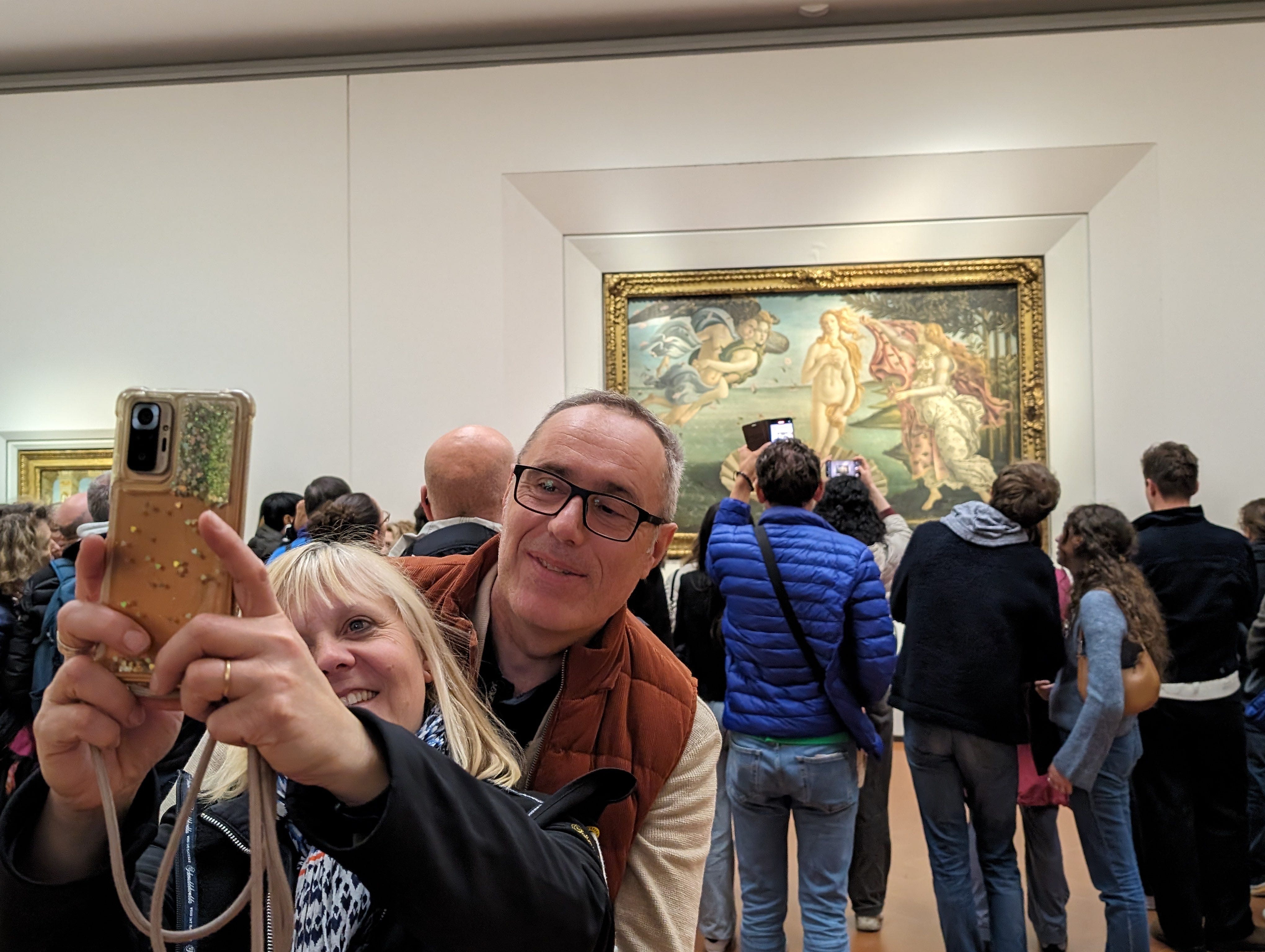
Botticelli was a pretty weird and tortured guy, judging from the way he fell under the sway of the god-mad preacher/demagogue Savonarola to the end of his days, but that is not his rep today. There’s interesting god-mad stuff all around his inscrutable trophy paintings, but hardly anybody looks at them.
(2) Strangely enough, Caravaggio painted another self-portrait of himself as a decapitated person 15 years after “Medusa.” He was seeking a pardon for murdering a pimp in a duel four years earlier, and painted himself as a slain Goliath, held out by David. It was a way of signifying penance.
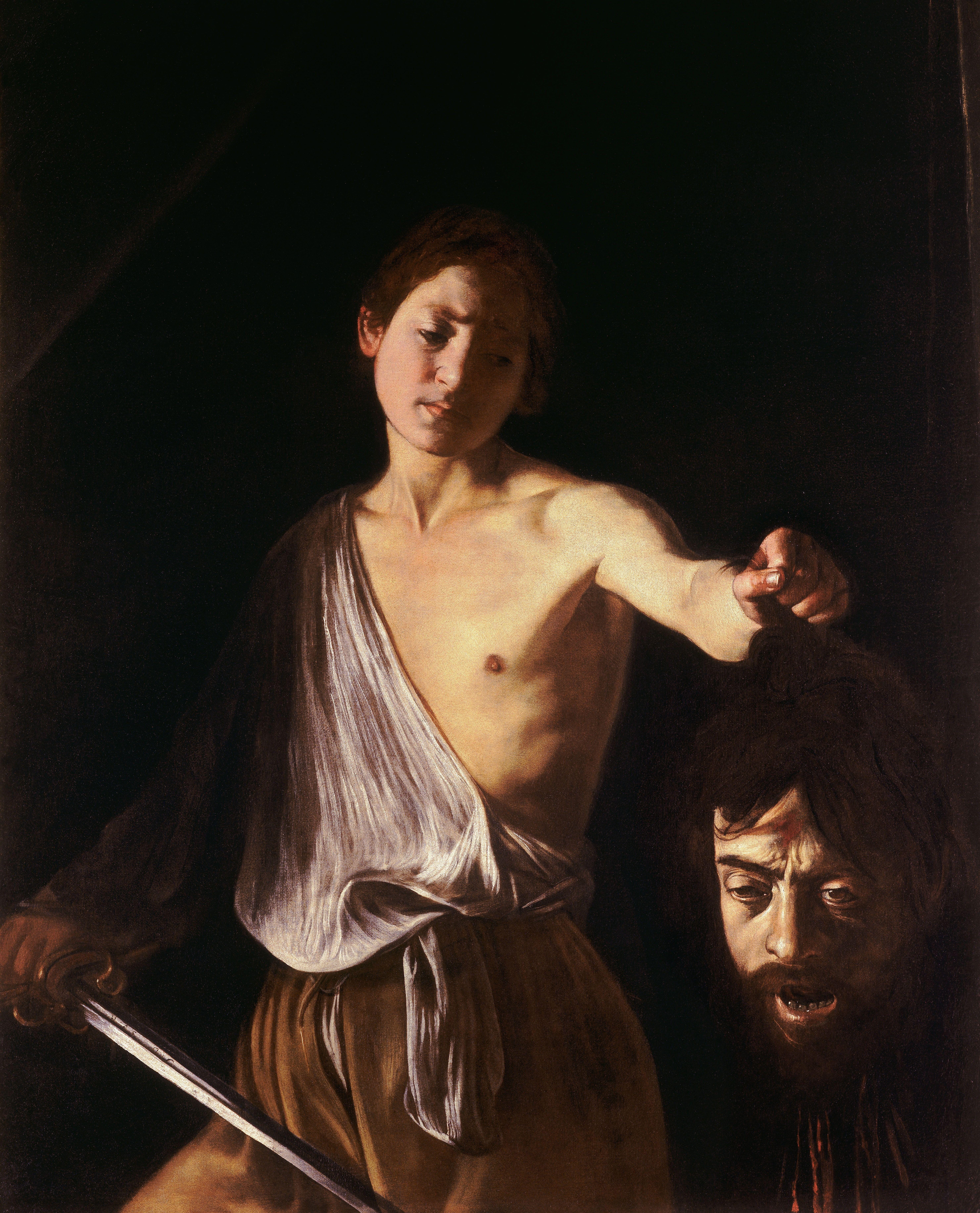
He was successful in receiving a pardon, but by the time it would have reached him he had died, possibly of fever and possibly of wounds suffered in a brawl.