

The global satellite project I mentioned last Sunday was called Iridium,1 and it turned out to be an epic bust, a $5 billion failure that stood out even among the many business catastrophes of the last millennium’s dotcom fiasco.2
It’s said that you learn more from failure than from success. Never truer than here, both for the clear business lessons, and for understanding my own failure as a reporter to assess the reality of what I was seeing.
Without doubt the project was inspiring: Iridium was a constellation of 70-odd low orbit satellites, designed to connect with each other and a series of ground stations for wireless voice and data service from any non-polar point on Earth. It was developed at Motorola, at the time a giant in wireless phones and telecommunications infrastructure, and then it was spun out as its own company (with Motorola as the prime satellite contractor.)
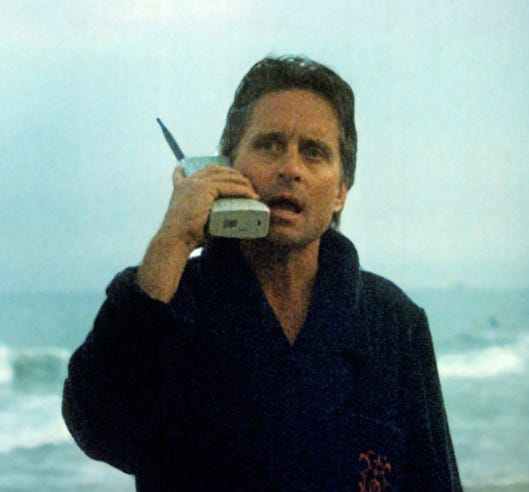
Understand, when this was hatched in the early nineteen-nineties, cell phone coverage was pretty limited. Cell phones were bricks, and cost $2000 (that’s $4200 in current money.) The per-minute charges were very high, but there are always ways that costs can be hidden or contextualized.
The inspiring thing wasn’t simply the global connectivity. Robert Galvin, the man who made Motorola a giant, told me that Iridium would eventually function as “a new skin on the planet,” with sensors aimed above and below, delivering all kinds of new information about Earth and its surrounding space, even as it connected people below as never before.
Not only that, since low-orbit satellites burn out quickly and need to be replaced, the increased launch demand from Iridium, along with a half-dozen other such global communications projects, with names like Teledesic, Globalstar, Odyssey, and Ellipso, would create incredible innovation in the rocket business. Investors funded companies like Kistler, Kelly Space Launch, and Rotary Rocket to make it ever cheaper to get all kinds of things into space.
Cool! Sign me up!
But vision can blind. Even as Iridium was weaving its satellite web, mobile towers were going up fast around the world, phone prices and phone sizes were shrinking, and per-minute charges for earthbound phone calls were dropping. The emerging Internet was an intriguing business possibility, but while Iridium’s data speed was fast enough for a disappointing fax, it was nowhere near the speed the new tech demanded. If you’re reading this on a 5G mobile network you’re getting your data about 300,000 times faster than what Iridium could do.
Collectively, that was a big deal. If Iridium couldn’t build a business in the present, it couldn’t build the future.
But those realities were not the fatal thing. Cost is relative, and even today there are plenty of places where you need satellite coverage to connect. The people who need it include the disaster relief workers of big governments and international institutions, rich owners of big yachts, oil companies with offshore rigs, and SEAL Team Six, which does battle in hard to reach places. These are what you call price-inelastic consumers, or dudes who will pay whatever it takes to get what they want.
In fact, Iridium execs had done internal studies suggesting the company could break even just by supplying all of the yachts in Great Britain. On its own, a big $2000 phone is bulky and pricey. Make it an essential lifeline inside something that costs hundreds of thousands of dollars, though, and it’s a reasonable extra.
But that isn’t how Iridium decided to see itself, and I was there when it made that decision. At a meeting in New York, top management and their advertising/marketing agency of choice discussed the alternatives. On the one hand, position the phones as industrial workhorses, advertise on the cheap in trade magazines and make the phones earn their keep with the aforementioned customers. On the other hand, create something commensurate with the glorious founding vision, position the phone as a new high-end tool for the global businessperson, and fashion a glitzy, high-end ad campaign to match. Vision!3
Reader, they married the glitz. And that was the fatal thing. That cutting edge, rich guy vision didn’t just come with ridiculously higher advertising costs, and higher marketing costs. There were also much steeper distribution costs; almost incredibly, the distributor would make less selling Iridium’s satellite phones than selling regular cell phones.
I was there in the room as a reporter, and I picked up on the romance, that collective desire for greatness. In fact, I’d say I internalized it, too. It was such a better story. I think my editors felt the same way; they loved my initial take. But after I finally got a phone and experienced its large size and crackly call quality, I found the facts were showing up differently. My editors spiked my newly-skeptical story. No blame on them. It’s on me that I didn’t change my mind faster and more decisively, and then fight harder for my new point of view.
A good lesson, whenever you learn it.
Iridium, Globalstar, and the rest of the constellations, along with me and many talented reporters, were caught up in the larger bubble of the time, and perhaps a little late to reality. The losses were probably in the hundreds of billions, taking down the good along with the foolish. Motorola, though, did okay, getting paid for building the hardware.

Then, a few years later, a newly-rich tech sharpie named Elon Musk saw all that newly-formed rocket talent going for pennies on the dollar, and amassed what became Space X. It was a cheaper launch company that initially survived on government work, then got private contracts, as the growing market for cell phones dramatically cut the cost of communications equipment.4
As it turns out, Space X now offers Starlink, a low-orbit global satellite network with fast Internet access. It seems to be doing pretty well, selling dishes and services to remote homes, workers in out of the way locations, and yachts.
Mr. Musk is more an opportunist and an integrator than an inventor, but - labels, who cares? He bought Tesla, too, and now we have an active electric car market. Satellite systems are abundant, launch costs are down, and it’s all here.
To a large extent, because Iridium and the rest of them were there.
Note: Everything here is about Iridium pre-bankruptcy. Iridium went bankrupt, and was then reconstituted with a sound business plan and good management. Full disclosure, I am a very modest shareholder, mostly for sentimental reasons.
“Dotcom bust” is a term that is with us for good, but the real money that burned in that bubble came more from supposedly sensible telecommunications companies than from the likes of Pets.com. Tens of billions were spent on wireless spectrum that no one was sure how they’d use, exotic satellite projects, optical fiber trenched at great cost next to apartments but never connected to them, and other hopeful capital expenditures. When prices collapsed a few companies dove in and got the fiber for pennies on the dollar. One was Google, which even then had its eyes on building big.
It’s possible that the ad agency, which printed really beautiful mock ups of what the global ad campaign would look like, might not have been the most sober and neutral party. After all, ad agencies are paid based on a percentage of billings, and a nationwide TV spot costs considerably more than a quarter page ad in “SEAL Team Six Monthly.”
Elon was hardly alone in this revival of launches and satellites. My friend Ashlee Vance has an excellent book on the many colorful characters who came up after the initial debacle and are now creating all kinds of interesting space companies. Check it out.