
Infinite Blues.
Sex, death, and why AI can't color itself out of language.

I once swam in a blue like nothing else. In the moment it was everything. Colors usually attach to something (red dress, green stoplight, blue sky), or exist as an ideal, like the yellow you’ll paint your home. Common sense says the blue I saw was light within the lake where I swam. But there was nothing common there: The blue was free of space and structure. It had a purity and a certainty beyond simple definition, more Eternal Mood than Perishable Thing. The color beckoned me to dive into it, the better to witness its deepening power, ever richer, until my breath ended.
I once nearly died of curiosity while swimming in the Pacific. In Guam there is a reef that falls away like a giant staircase, each step perhaps 20 feet below its predecessor. The change in light and temperature between each level creates a unique ecosystem of plants and creatures. I swam down as long as I could, fascinated by the multitudes of life and color at each level.
When I could go no further I looked to the distant surface, unaware until then of the distance I’d traveled. It was a terrifying return: I was desperate to inhale long before I burst through the surface. I reached air barely able to float myself to shore, where I lay for over an hour, careless of anything except recovery.
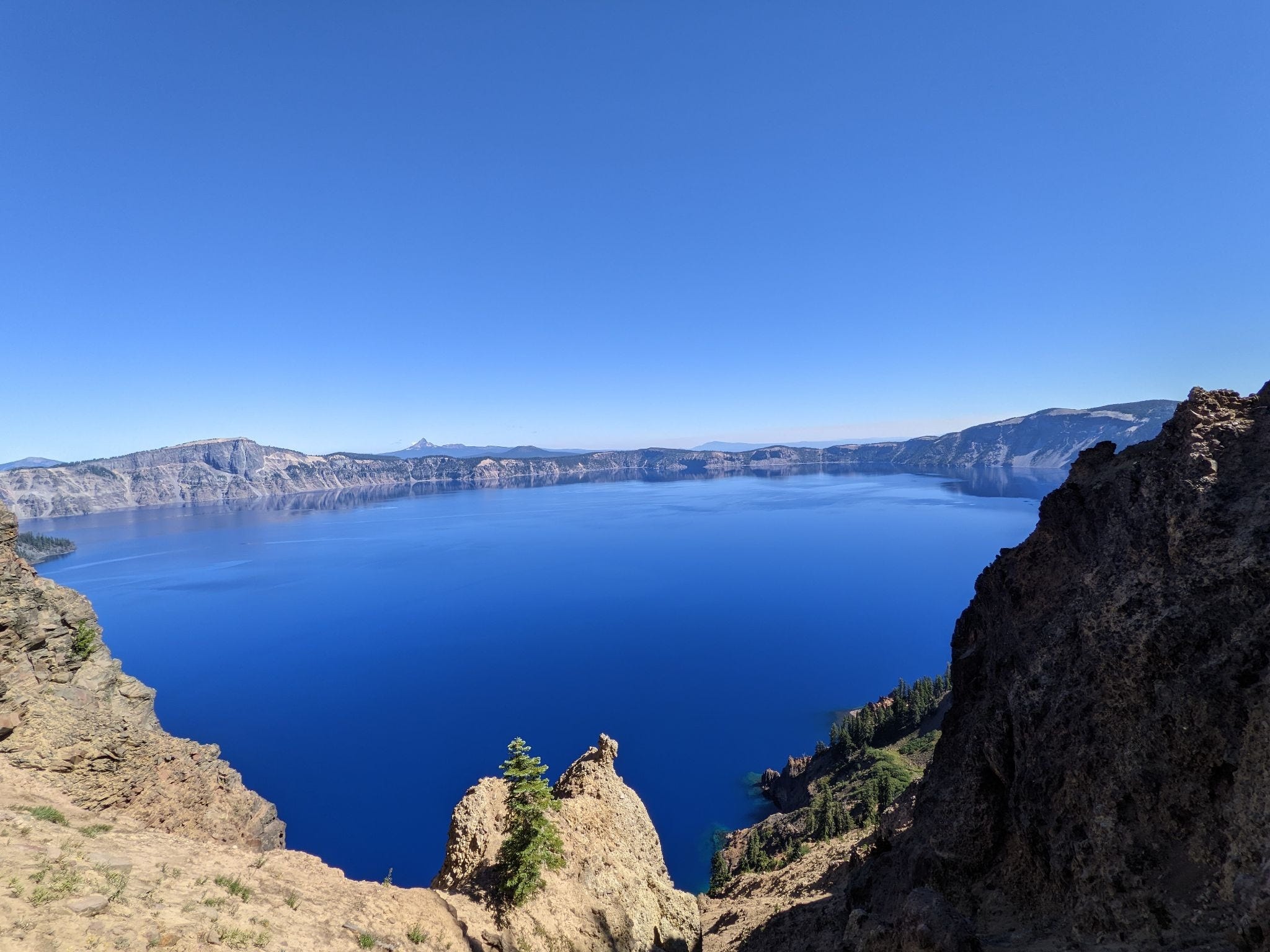
My blue lake dive was completely different. I was not investigating the lake’s ecosystem. I was enchanted by its singular undefinable blue, though Oregon’s Crater Lake, the deepest body of water in the Western Hemisphere, has a disorienting natural history for swimmers. Large pumice rocks float past, big as a basketball and light as a sponge. A hemlock tree has drifted there for 450 years, bobbing without becoming fully waterlogged. The water is icy even in high summer, but the swimmer leaves reluctantly, since the water’s clarity is captivating.
“Crater” is a misnomer. The lake, nearly 2,000 feet deep, lies inside the caldera of a onetime volcano, 12,000 feet high, that exploded in 5,700 B.C. Twelve cubic miles of magma blew out, and 4,500 vertical feet of volcanic cone collapsed into the sudden vacancy. Over the next 250 years the lake was formed entirely from sky, rain and snow melt. Even today the water is so pure that one may see objects 140 feet below the surface. Light continues its conversion to heat and fuel well beyond that, reds first and so down the spectrum, before fading to darkness. Light feeds ancient moss 600 feet down, the deepest photosynthesis on Earth, using one-thousandth of 1% of the brightness of the lake’s surface, short waves of residual blue light.
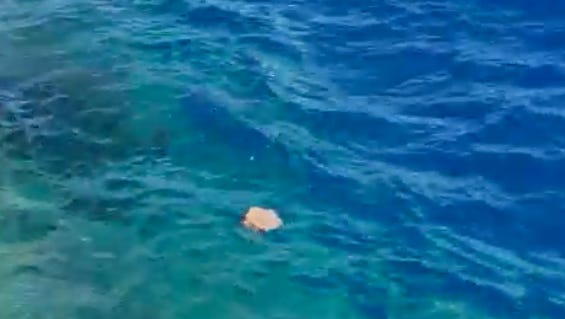
I witnessed my pure blue a few dozen yards from the beach, where the lake bed meets an underwater cliff. What was visible ground becomes endless unformed blue. It’s ever more concentrated the longer you stare down. Every swimmer I’ve watched there turns soon after the cross over the cliff, though they were in no more danger than they had been just a few feet back. The sight of blue darkness at the center of vision is simply too rich and troubling.
These were two Siren songs, then, Guam and Oregon. One sings of the numbered richness of the natural world. The other is entirely itself, and suggests a passage to something I can’t name. The ocean’s song almost killed me out of reckless fascination. The lake’s song touched me more deeply, but I too swam away. Even now at times, living instead of diving into the blue can feel cowardly.
Blue has that hold on our minds. In “Bluets,” the poet Maggie Nelson writes of her love affair with this color, called “primal,” “the fingerprints of God,” with meaning beyond meaning. It is the color for a place, she quotes Ludwig Wittgenstein, where “explanations come to an end.” She associates it with her lost love affair, primal in its sexuality, that made her feel alive like nothing else, for all its “morbid heart.” In “On Being Blue,” William Gass associates blue with our interior life. He revels in its varied uses (blue laws, blue periods, having the blues, blue moons and bloods, and much blue sex besides) showing the reader the necessity and impossibility of truly depicting reality with language. And yet we must try as much as we can. We work in words and their limitations, even as we desire more.
Both writers notably take blue as a color of erotic life, our most direct experience of existence without language, and our closest intimation of the life force that will pass through us and continue when nature is done with us, to a place beyond speech.1 If sex is both pre- and post-language, this may be why most writing about sex is bad, and most of the decently-written portion of sex writing is about bad sex.
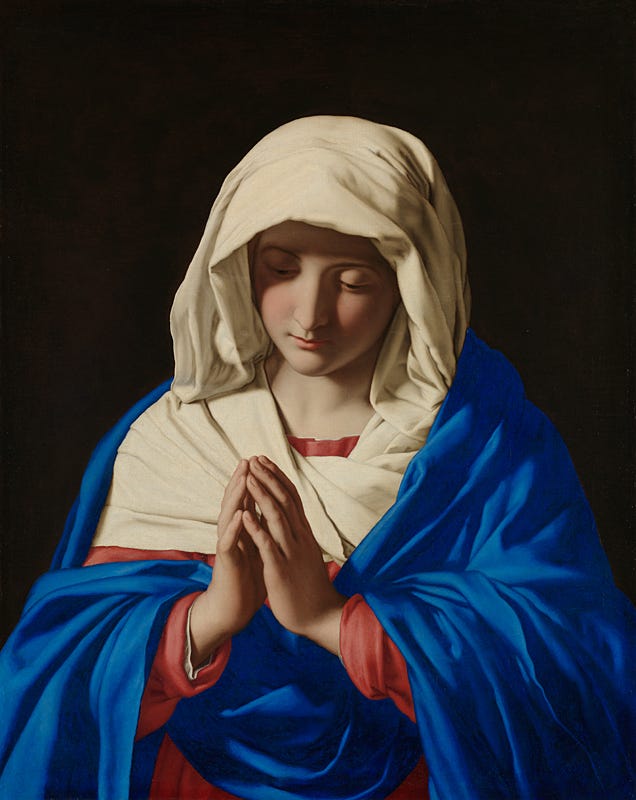
There are people in North Africa turn themselves blue intentionally by wearing indigo cloth; the Moslems who failed to convert them called them Tuareg, or “Without God.” They call themselves Imashaghen, or “Free People.” Western painters could not depict intense blue until precious lapis lazuli from Afghanistan, deep and pure, became available. Thereafter it became the color of the Virgin Mary’s mantle, the mandorla surrounding the risen Christ, and whatever else a rich patron wanted to show had inestimable value. While the Romans disdained blue, old Islam held it a color of dark magic, and China thought it signified torment. In today’s globalized and increasingly disenchanted world, blue is the most popular color by far, seen on our young jeans to our aging hair rinse.
The blue I saw in Crater Lake, unattached to anything, was blue in its infinite state, the living expression of Maggie Nelson’s thing beyond words, William Gass’ touchstone for the limits of language, the ineffable sacredness of the mandorla, an unbounded freedom I, we, intimate. As mortals, existing in only the tiniest crack in eternity, we yearn for more, the “more” of infinity, either physical or spiritual.
That was the blue that beckoned, and if it had killed me, likely that would have been incidental to the blue itself, as it was timeless.
* * * *
Infinity is today’s great seducer, the final dream of Reality, Unlimited. The scoreboards of our ultra-wealthy are superficially in the hundreds of billions, or now talked about as trillions with a straight face, but they might as well be “infinite money.”2 The unimaginable richness of every life on Earth is endlessly documented and stored, with more sensors on the way. We can’t store enough, we can’t stop counting and numbering things. The current fad for living forever, an idea no one can really grasp3 even though thousands seek it out, just hit a notable wall, but it continues.
But our closest romance with infinity today is with Artificial Intelligence. Large Language Models are constructed in ever-greater size, with the assumption that the only thing better than 10 trillion parameters is 20, no make that 30, and performance will continue to improve forever. Coursing through ever-larger data centers, eventually we’re supposed to have an AI “superintelligence,” which will far surpass us, supposedly the smartest creatures in known creation, and it (they?) will work on themselves to create new sensors and means of understanding, until perhaps the unified field of physics, long sought by our best minds, will be one more achievement on the way to infinite understanding.
Dreams of the infinite are paradoxically dreams of culmination. Which is to say they are dreams of apocalypse, a common fear and desire across thousands of human generations. What color would that take?
This week I was thinking about the beckoning blue I swam across, and our love of the fatal infinite, when I asked various popular AIs what color pure AI would be.
It would be blue, and it would not be enough.
ChatGPT
ChatGPT, along with Claude and Google Gemini, initially tried out the non-choice of “iridescent,” an attribute, like iridescent green, or a shimmering mixture. AKA a waffle, designed to please everyone — perhaps what you’d expect from software that scrapes everything, and gets fine-tuned to please its human and maybe sell some ads. Eventually ChatGPT came up with this blue.

“The cool rationality of blue and the imagination of warmer tones.”
Claude
Claude’s choice was more argument than mood. “Historically it’s the color of things that were rare and slightly suspect: royalty, mysticism, radiation warnings in old sci-fi,” the machine wrote. “Powerful, expensive to produce, and nobody’s entirely sure whether to revere it or be wary of it.” In other words, it came to its color by a language game. And failed: Reader, does this smack of royalty and mysticism?

“The last thing your eye registers before the spectrum keeps going without you.”
Google Gemini
Gemini got to this after offering me several choices of colors, and waffles like “let’s drop the fence-sitting: grey…the ultimate neutral,” followed by “red, an absolute refusal to be neutral.” It was like an encounter with the most embarrassing adolescent date, trying to figure out what to be so you would like them.
At last it produced this blue, a “synthetic” color without anything to latch onto. It came closest to the color I saw, which still isn’t very close.
“A synthetic color that feels like a physical void on the canvas, drawing your your eye in but giving you absolutely no texture or depth to latch onto.”
How could I have expected anything different? This is software made entirely from language, and it cannot intimate the primal and eternal world beyond language. True blue is everything before language and after. But language models have only words, and not the experiences we suggest with language. They sit apart from desire, since unlike us they are exclusively trapped in language, more able to depict the ecosystems of Guam than the unreachable color in Crater Lake.
For some people, particularly the ones who fall in love with chatbots, that may be enough. Particularly if they’ve never seen the real thing, and then swum away, wondering forever about what they witnessed, and where they might be going.
As Wittgenstein also famously wrote, “Death is not an event of life. Death is not lived through.” Therefore it can’t be talked about particularly usefully, except as the absence of someone among us, the living.
If Elon Musk kept his $917 billion in a high-interest savings account yielding 4.5%, he’d have to spend $113 million a day for it not to grow larger. If he then spends an extra $1 million a day on top of that, $114 million a day, $80,000 a minute without stopping once for a moment’s rest, he’d burn through all his loot more than 2,000 years from now. See what I mean, in terms of inconceivability?
Don’t believe me? Here’s a thought experiment: Suppose you were granted two good lifetimes, 80 years each. If you were now at the end of your second one, you’d have been born in 1867, an impossibly distant year. Four lives, 1707; you probably couldn’t function with that much experience, and four lives is infinitesimal against the thousands upon thousands that go into “forever.”
I like 'ama-iro' 天色 best. I even have a bottle of ama-iro ink that I use for writing.
I can’t help but think of my continuing awe at the infinite varieties of blue sky in the southwest and mountain states, free from the “white skies of summer” in the mud-Atlantic states, driven by the soggy humidity that pervades that region.