
Human Moments In Hell
A hidden thread to women's fates in a frontier state.

This is a story of anonymous sisterly love in a hellish place: The Oregon State Hospital Museum of Mental Health. The museum provides an unlikely record of the strange times and hard tales in a psychiatric hospital in a Western state.
The film “One Flew Over The Cuckoo’s Nest1” was partially shot on the hospital and grounds of this institution, primarily because of its dark atmosphere. If anything, the movie undersold that mood. It was foreboding when I visited on a brilliant August afternoon. The museum was probably built to capitalize on the success of the film, since there is a wing dedicated to its production. Yet that is the least interesting part of the place, which everywhere else is given over to the lives and conditions of the inmates in an earlier time.
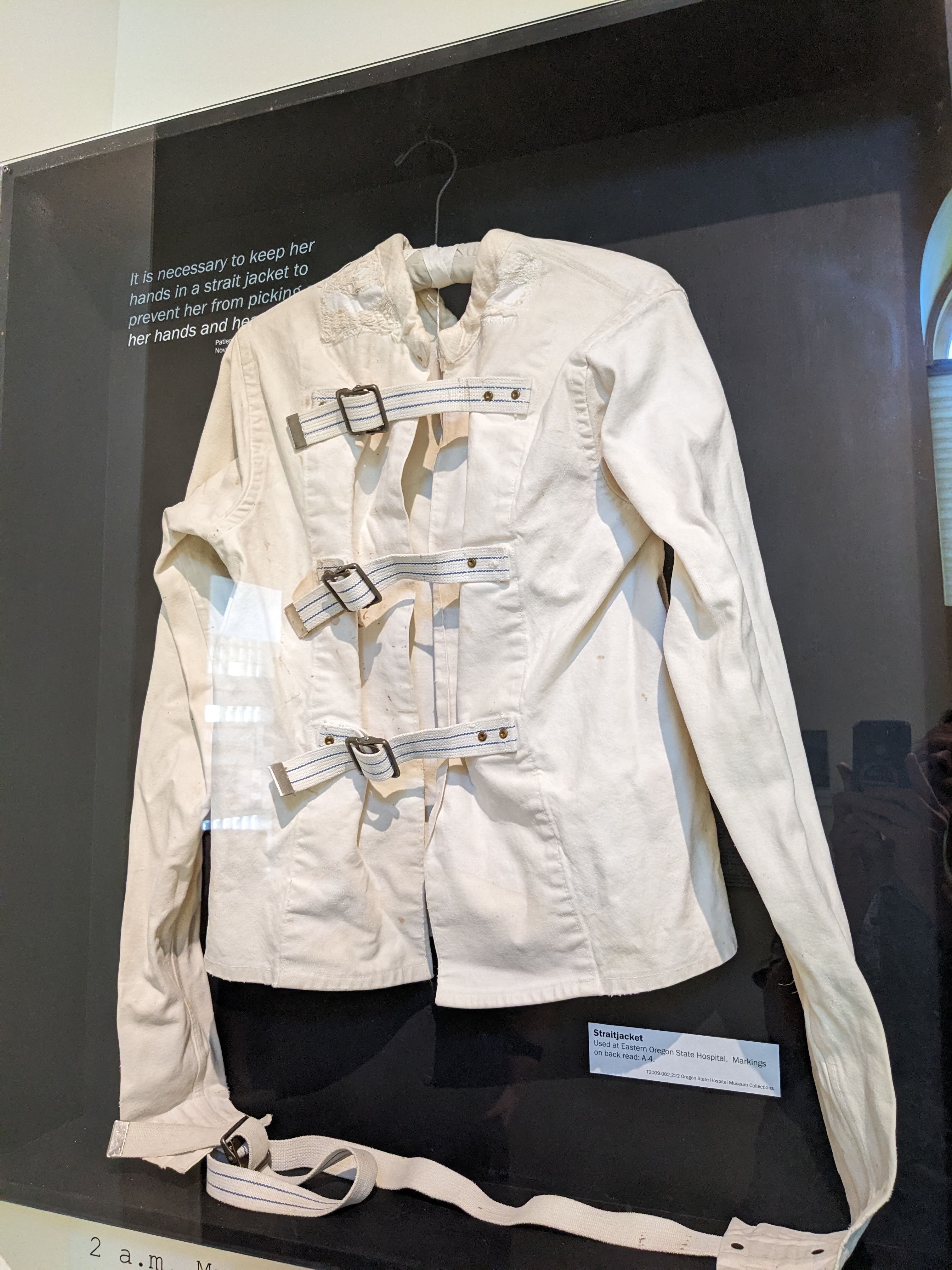
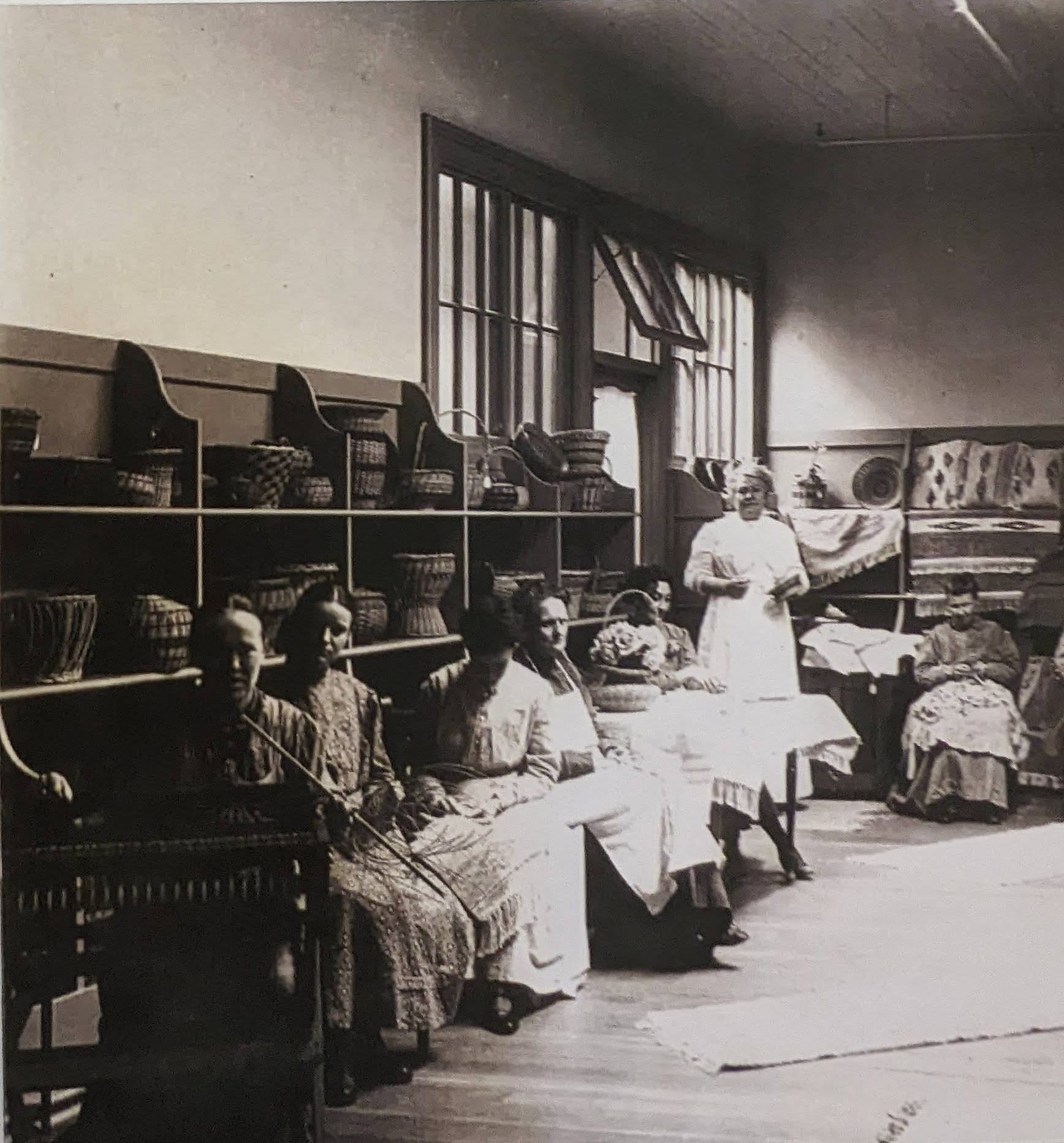
It was in one of the first rooms that I saw this straitjacket from the women’s wing of the hospital. It got a lot of use, and there were many like it. Elsewhere in the hospital, women who were not under restraint were assigned to various industrial crafts, including sewing. (Men mostly worked outdoors, leaving little record of their time at the hospital.) Female inmates made this straitjacket, along with overalls, mittens, restraining sheets, and pants.
The sewing department also made repairs. Look closer:
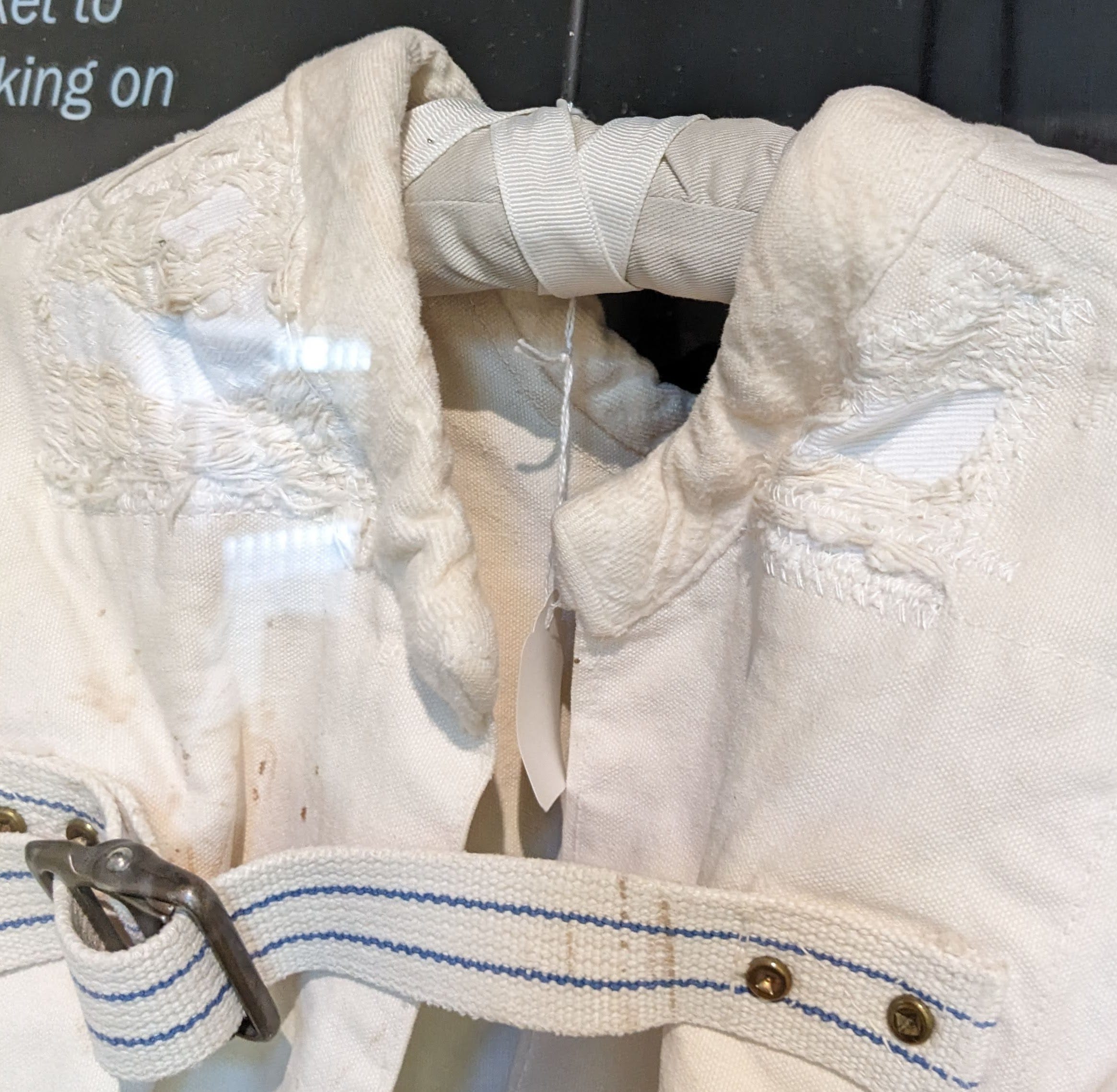
The item, most likely worn away in those areas around the head from one or more women biting at their confinement, was carefully sewn back together in an attractive pattern. One inmate was giving another something - can we use the word in this context? - pretty, a little adornment, on the jacket she was forced to wear. The sewing certainly shows care, and I hope it was a comfort, as I believe the seamstress intended it to be. I brought over a docent to examine the jacket, and she was also startled. The hospital had never noticed this human detail in the confining device.
Oregon today has a reputation for abundant nature, an attractive coastline for RV travels, big mountains, and the cliche that Portland is a flaky left-wing city. Its founding history is harder; it is the only state that was admitted to the Union with “whites only” laws, in place not only during its frontier days but also embedded in its constitution [later removed.] For a time, free blacks there could be flogged if they stayed too long. Native peoples were pushed out, massacred, and declared insane. While working in the industrial crafts part of the hospital’s labor program, many native women appear to have been tasked with making blankets and baskets for sale.
One can make connections between the stated reasons for commitment to the mental hospitals and what was happening in Oregon in the late nineteenth and early twentieth centuries. In those days, anger at big business spilled over into anger at saloons, where populists said people were being manipulated, their votes gathered up in exchange for liquor. As a result, Oregon became an early prohibitionist state. “Alcoholism,” however defined, was a cause for incarceration in the mental hospital. Oregon also had an early suffragette movement, a source of more strife, with at least one early feminist declared insane by her husband.
That suffragette, Winnie Singer, was the granddaughter of pioneers and author of the song “Ballots for Women.” She was committed in 1915. When she got out, she sued the hospital and several individuals for wrongful confinement. In her testimony, her incarceration reads like serial torture and humiliation: She was strapped to a bed; she was kept in isolation; she endured cold plunges; she was forced to drink noxious substances; she was made to stand naked in front of strangers. She won her case in 1917, only to have the verdict overturned by the Oregon Supreme Court. She was hospitalized again in 1920, we do not know why or under what terms, and she lived the rest of her life in mental institutions.
I know this, and other stories, including accounts of a couple of men who did a little time for drug or alcohol use, because of several biographies of patients that the OSH museum has posted on placards. While this is questionable in terms of their right to privacy, there are many heartbreaking reads. I’m thinking of Fannie Hostetler, who was committed in 1914 at age 53 for paranoia, on the basis of testimony from neighbors. She was freed two weeks later because 60 other people provided affidavits saying the neighbors’ testimony was false. She was recommitted permanently in 1923 for being suspicious and mistrustful of her neighbors. Can’t imagine why.
These biographies are part of the museum’s chillingly disinterested account of this history. There are no apologies. There is a list of reasons why, in the early 20th Century, one might be incarcerated in the hospital. These include Abortion, Alcoholism, Apoplexy, Childbirth, Excessive Reading, Family Trouble, Hysteria, Jealousy, Living Alone, Love Affair, Masturbation, Menopause, Menstrual Trouble, Miscarriage, Nostalgia, Pregnancy, “Probably Pelvic Irritation,” “Probably the Stress of Army Life,” and Puerpera, or being a new mother.
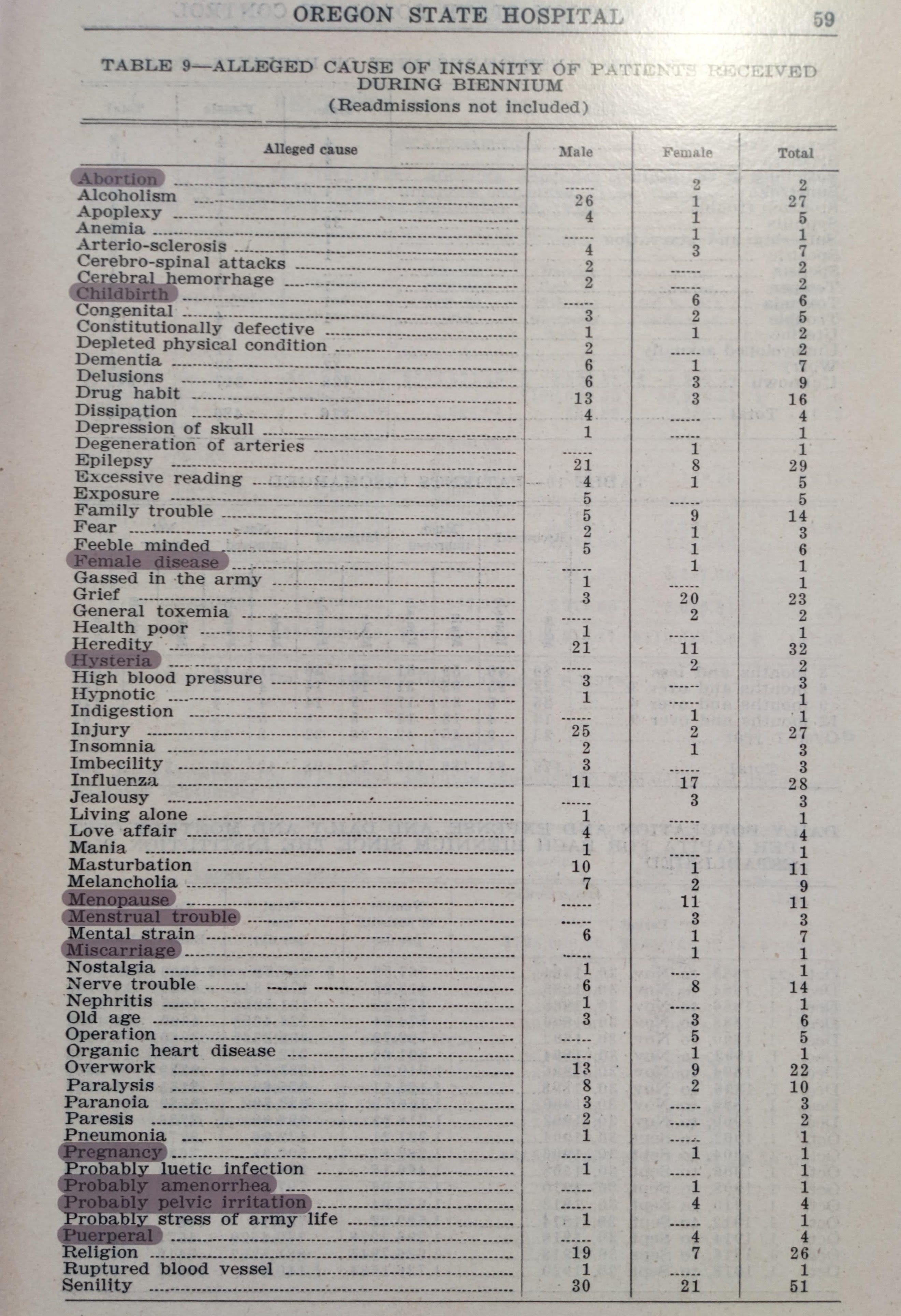
As you can see, a great number of these reasons have to do with being a woman. Others are about not fitting in. Conformity wasn’t simply coerced, it was rigorously imposed, sometimes if one read too much or had postpartum depression. There were few effective treatments, but there was a consensus that slavish work was part of the healing process. For a frontier state informed by racism, which is arguably its own kind of mental illness, the pressure to conform went literally to mad levels.
And yet, judging by just a thin white thread hiding in plain sight, some of those inside retained their humanity. As people have done in many such places, whenever they managed to keep alive a modicum of compassion for their fellow sufferers.
This post is primarily about how, in a highly conformist society, even to the point of conforming to a racial standard, people who didn’t make the grade were incarcerated and enslaved. In particular, women. Which makes it more than a little ironic that the film “Cuckoo’s Nest,” with all its lip service to rebellion, is also a very macho affair. The oppressor in the mental hospital is the female “Big Nurse,” complete with sadistic restraints on herself and others. The men are kept down by being put on drugs and being forced to watch dumb TV. There are no female inmates. The moment of liberation is breaking out so all the guys can go fishing with some floozies.
Ken Kesey, author of the novel on which the film was based, didn’t like the picture, primary because it downplayed the person he considered the main focus, the Native American inmate, Big Chief. On the same trip where I visited the OSH, I went to a Eugene, Ore., Emeralds AAA ball game. They were celebrating local hero Kesey, and the Merry Pranksters, his LSD-promoting organization, which staged light shows, happenings, and all-night dance parties. In an opening video Ken Babbs, a close Kesey associate, said, "We never tried to harm anybody or make fun of anybody. Enjoy yourself! That's what it's all about." He had a point.

My book group read a book called "The Woman they could not Silence" by Kate Moore. You should read it. Illinois metal institute. Her husband commits her. The author needed an editor, but other than that - it is a harrowing look at how women were treated in the 19th Century.