
Here Lies The Truth
The great novelist and modern memory

“The lies about the West are more powerful than the truth about the West - so much more powerful that, in a sense, lies about the West are the truths about the West - the West, at least, of the imagination.”
-Larry McMurtry, quoted in David Streitfeld’s Western Star
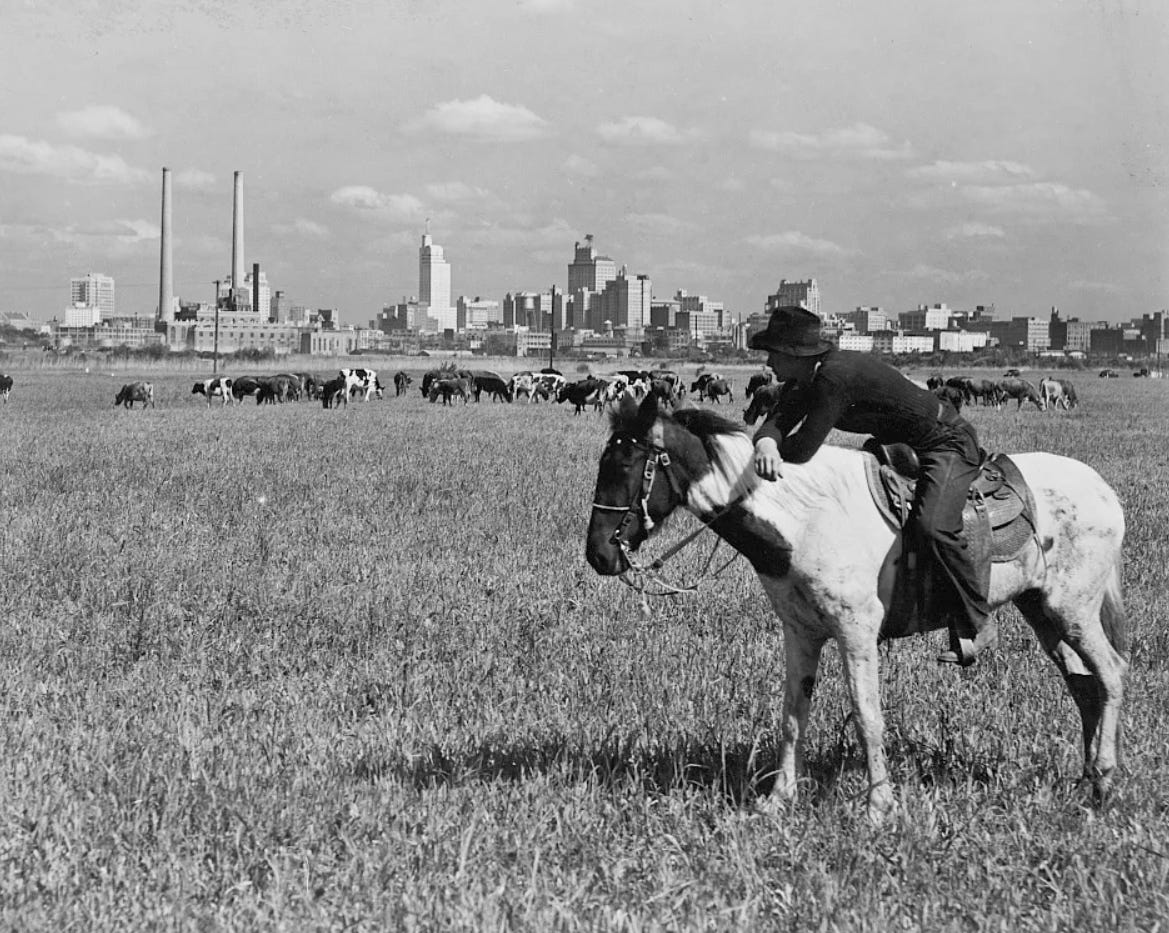
Novelists are liars. It’s nothing personal, just the job.1 They make up people and plots in the interests of exploring higher truths, like “here, then, is the human condition,” “this is the tragic psychology of desire, reverberating down the generations” or, more prosaically, “people love a really good yarn.” Sometimes they lie to reinforce cultural touchstones, like “the cowboy was a self-sufficient loner who tamed the wilderness, thereby wiping out the need for him. It’s noble and tragic.” There’s good money in that kind of reassurance, and considerably less in debunking popular illusions.
The best writers are frequently professional betrayers, too, ransacking their personal history for material, revealing family secrets, even rewriting their own life stories to make them more interesting. Many others among us do these things too, but for smaller audiences (sometimes an audience of one, residing between our ears.) Novelists go big, though, and if artful enough in their betrayal they are forgiven by everyone, except their families.
I’ve been thinking about these eternal truths about lying and betrayal in new ways since reading my friend David Streitfeld’s literary biography of Larry McMurtry, Western Star.
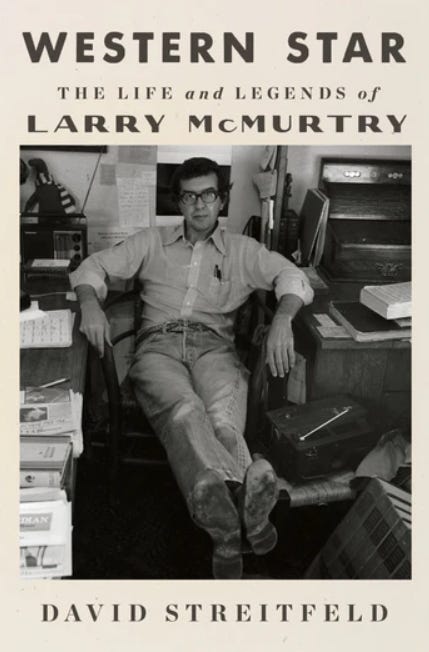
McMurtry and Streitfeld were friends for many years before Streitfeld broached the idea of a biography. McMurtry put him off for many more years before equivocally okaying the idea. It’s fair to assume that by then McMurtry knew that Streitfeld, who I can attest is passionate about capturing facts and exposing hypocrisies, would explode many of McMurtry’s abundant personal fictions, even as he captured McMurtry’s long project of exploding the most cherished myths about Texas and the frontier. Which even from the jump shows McMurtry’s interesting allegiance to exploding personal myths, too.
To what end is tragically hard to say, for this book also depicts a time when quality fiction steered the culture, and writers competed fiercely to nail exactly what it meant to be alive in their times, debunking myths and steering people to a greater awareness of their own lives. This meant not simply reading Kesey, Mailer, Bellow, Roth, Oates, McMurtry, Lessing, Morrison, and many others, but internalizing what they had to tell us all, and following discussions of their work in the popular press.
Not long ago some 400 daily newspapers carried book reviews. That figure has fallen by 90%. All the major papers had separate sections devoted to books and ideas; the founder of Amazon.com recently closed the Books section at his Washington Post, leaving The New York Times the only high-profile paper with a notable standalone Books section.
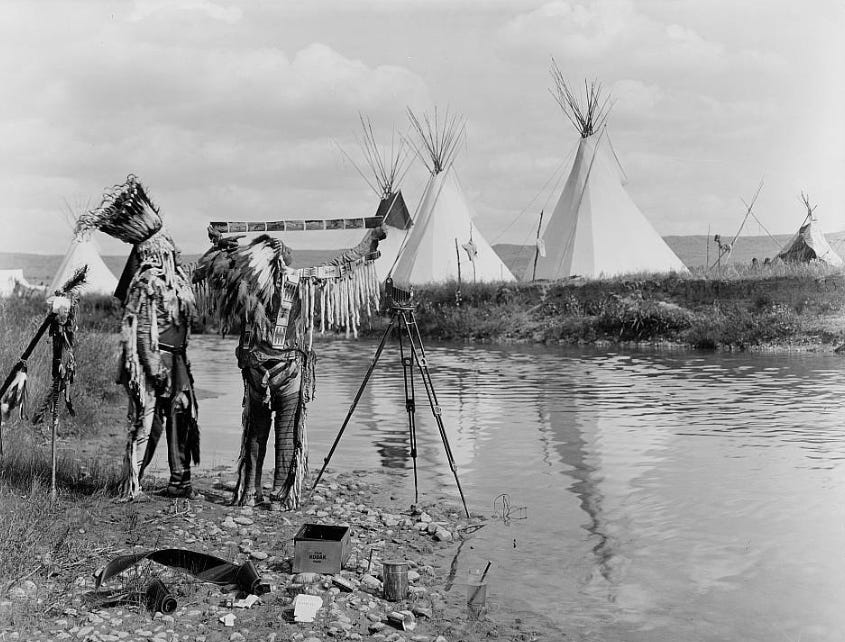
Very quickly, life on the frontier of Literature has come to seem almost as remote as life on the frontier of the Old West. That type of (may the muses forgive me) thought leadership role for Literature is long gone. It surrendered first to movies. Now all manner of digital media has created a culture of hyper personalization that threatens any attempt at cultural consensus. Memoirs abound, meaning that betrayal of family history chugs along, but for the most part these are personal stories. We don’t look for them to explain our shared psychic realities.
I’ve written about feeling ghosted by the culture, the hazards of hyper personalization, even the new personal soundtracks in our heads. I have much sympathy for Streitfeld’s elegaic description of this bygone era.2 Even so, the most interesting thing is Streitfeld’s sustained passion for naming places in that halcyon literary past where McMurtry and others don’t have their stories straight, where they have their facts wrong, where they outright lie. As I said, McMurtry knew what he was getting when he let Streitfeld in, which is to say some part of him must have wanted his own myths demolished.
Streitfeld debunks false memories the most when writing about the 1950s and 1960s, when books mattered most. McMurtry says his childhood home was bookless, and no one read to him. His father remembers otherwise. McMurtry can’t really decide if he grew up on a place called Idiot Ridge. His first literary agent was not, as McMurtry wrote, a once rich person from a castle on the Danube. He misstated her age by a decade. He says he didn’t hang out with the LSD crowd of his friend Ken Kesey, but others say he did.3 Another friend spins stories about himself, Streitfeld writes, “even less tethered to reality than Larry’s.”
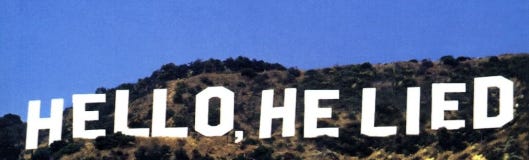
Once film takes over the culture, Streitfeld becomes more forgiving of myth-making. During a long section on the filming of McMurtry’s The Last Picture Show, a fictionalized take on his hometown of Archer City, Texas, there are no fact checks or corrections. Perhaps all of those Hollywood people tell their stories straight, let the chips fall where they may…oh wait, they don’t. They are from an industry best described by the title of producer Lynda Obst’s memoir, “‘Hello,’ He Lied.” It is customary in Hollywood to bullshit even more than you are aware of, since it’s a professional tic. Maybe it doesn’t matter in the same way that lying did when the world was different, and the fictional truth-tellers ruled.
After “The Last Picture Show” was a hit, McMurtry is headed to becoming largely “Lonesome Dove, Inc.”, a highly-paid storyteller who becomes wealthy off his long novel and4 miniseries about a couple of trail drivers past their prime, out for the validation of a last roundup. As McMurtry accedes to the sentiment and payoffs of Hollywood and television, Streitfeld interrogates people’s stories less frequently and finds them wanting only a handful of times, compared to the scores of “gotchas” during the literature-dominant earlier time.
His closest fact-checking the later years is for McMurtry’s work on “Brokeback Mountain,” the writer’s own last roundup, when he worked the art as he used to (and scored the big bucks and the important awards, whose ceremonies he is pleased to attend.) Even there, however, Streitfeld has a new tone of forgiveness. His final fact check, concerning the mistakes on a sign in Archer City honoring McMurtry, ends with, “it’s a start.”
Like many people who live by their wits, McMurtry presents interesting paradoxes. While he aimed for greatness on the order of a Dickens or a Fitzgerald, both of whom wrote themselves out of obscure circumstances to cosmopolitan triumph, McMurtry perversely reveled in his supposed marginality, and the obscurity of the Texas Panhandle. In fact, he was captivated by the land, or more precisely the land’s unique effect; his characters are entirely the product of their landscape and their psychology is resolutely place-specific. People in his books are consumed by memory, whether it’s a Vegas showgirl dwelling on the times when her body was best, or somebody recalling the candy bar left to bake in the Texas heat, or any number of frontier types lost in a time when they had more purpose. Yet everyone moves forward, seeking a new place to bring their memories.
On a personal level, McMurtry fled his hometown, a cultural wasteland, only to return there and build a bookstore with 600,000 volumes. Inflicting that much culture on your culturally arid roots must go down as some of the most performative capitalism ever attempted. The locals didn’t care one way or another, but he persisted. A person of recondite tastes, it’s doubtful he saw himself as nothing but the product of his pinched landscape and his grudging frontier ancestors, but he avidly chose not to escape, too. He even arranged the lie that he died in Texas.
Yet for all that, he agreed to have his own myth fact-checked, almost certainly knowing how much wouldn’t stand up. Much like the myths of Texas itself, which he tirelessly tried to explode, but ultimately profited from better than any other writer. And which, ultimately, he chose not to escape. There were in the end four books each based on “The Last Picture Show” and “Lonesome Dove,” fiction based on the landscapes of his personal and family past.
A paradox joins two things that contradict each other, yet their combination nevertheless reveals a truth. You could say the same of a novelist, that professional liar, signing up a biographer, his friend, to ferret out his lies, so people will know him for real as the fabulist he was.
They are also frequently drunks, adulterers, thieves, jealous monsters, and prisoners of despair. Lots of other people are too, however. Novelists just write novels about it. Ian Frazier once wrote a wonderful piece about Samuel Beckett, imagining if he’d made good on his plan to be a commercial pilot, and flew like he wrote.
In fact we used to talk books a great deal when we sat next to each other at The New York Times, probably more than we ever discussed cloud computing, the app economy, or influencers.
He later marries Kesey’s widow, another romance with the past.
To me, tedious and laughable. Sorry America, but that snake scene is straight out of Toho Studios.
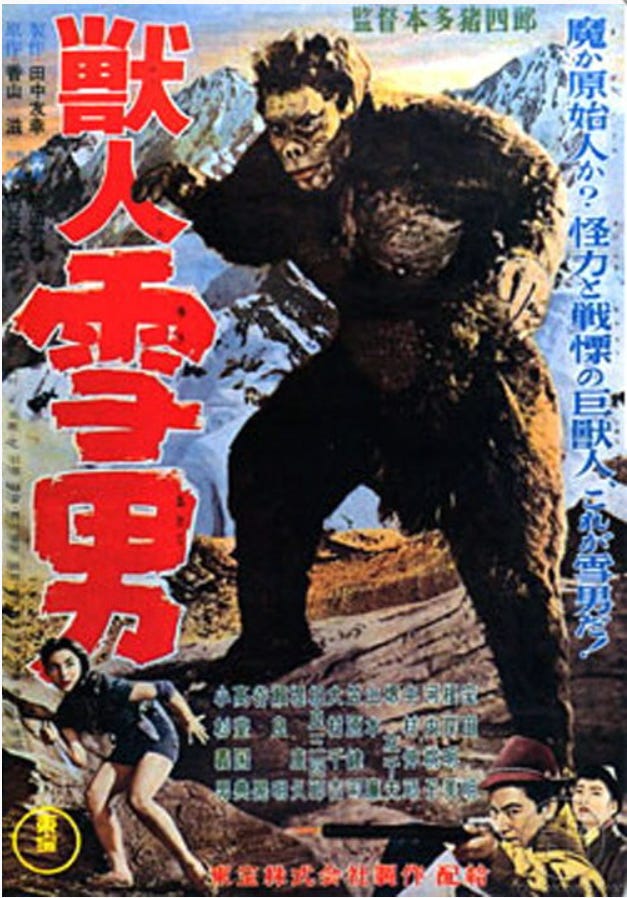
Not that there’s anything wrong with that.
Allegedly Josef Stalin loved Westerns.
Your best one yet - nailed it