
Disappearing In Time
The Michael Rockefeller Wing Versus Our Civilization's Paradigm

Granted, we think our selves and our world are pretty solid and orderly. We don’t really acknowledge that we’re 60% water, or that the total cells in our body are about 50% other creatures, mostly bacterial cells. I mean, what are you supposed to do with that? People say we’re 99.99…% empty space, too, because atoms are mostly vacant, but luckily quantum physics suggests that space is clouds of indeterminate particles that rarely participate in time. Whew, I guess.
Maybe the shocking thing is the way we think of ourselves as solid beings on a linear journey through time. I know I do. Moreover, I associate my creativity, culture, and politics with a similar unshakable story: Tigris/Euphrates, Assyria, Egypt and Persia, trade to kingdoms in India and China, Minoans to Greece, Rome and all that follows. It may be loosely coupled, and capable of heartbreaking catastrophes (check out the amazing Fall of Civilizations podcast for several), but in my library I can gaze out over it as one big continuous story. All as I move through gently time, a nice solid Quentin.1
Last week, though, I was in the new Michael Rockefeller Wing at New York’s Metropolitan Museum of Art, and I got a fine intimation of life and art through different eyes.
Maybe geography is destiny. Most of the art and artifacts in the Oceania display were made by people who live around, in, and on lots of water. Fresh, brackish, and salt water, often intermingling. Species diversity is abundant, but nutrients rapidly wash away in heavy rains, so the soil is poor. Where the people are sea goers, light is extraordinarily critical, whether it’s reflected on wave currents or emitted by distant stars. Organic materials rot quickly in the heat.
In continual change, one identity continuously intermingles with another. This geography of change seems to shoot through the art.
The most startling art in the Oceania collection comes from the Asmat people of Western New Guinea. They live among tidal rivers and mangrove swamps over 175 miles of coast. It has been largely undisturbed by outsiders, which to our minds makes it “timeless.”2 It’s a place of constant change, where life and death are equally permeable. Spirits of the dead live in trees and birds, but also in an after-world of ancestors which the living can invoke.
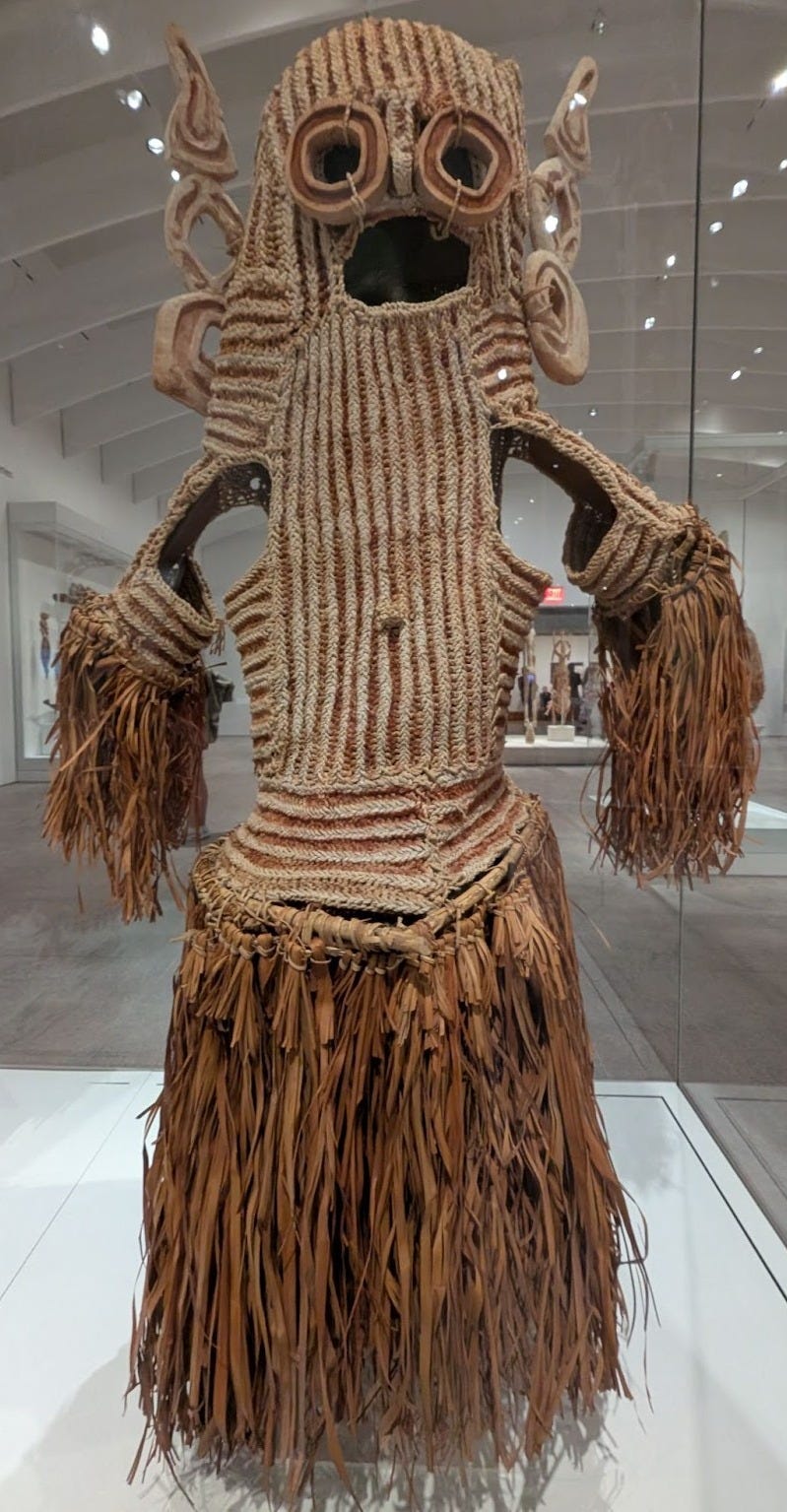
The art itself is magnificent, but one of the startling things to me is that it is intentionally impermanent. The body mask above was named for a specific individual. The dead person, embodied by the garment and its wearer, danced with the living long into the night, and then everything dissolved.
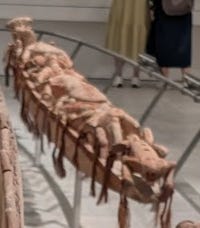
It’s the same for this war canoe, created to be used once in a ceremony that blends the spirits of the dead with the coming of age of young men:
Or for these astonishing bis poles, created as a prelude to a headhunting expedition to restore the village life/death balance.
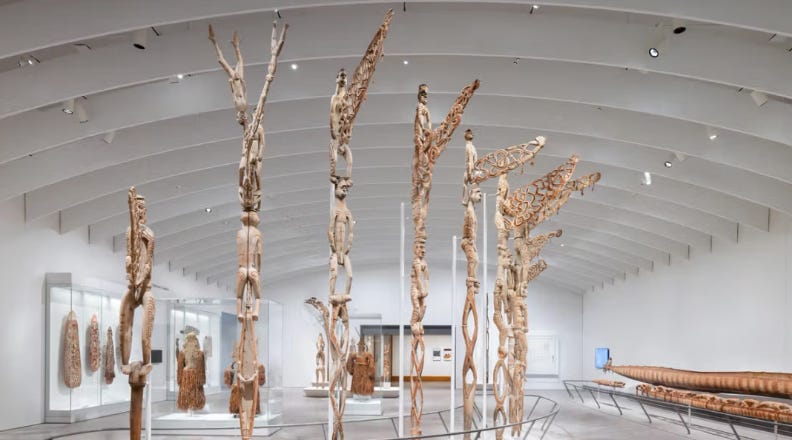
After a mock battle between men and women, the tribesmen would go forth to take and consume heads. Then the poles were purposely left to rot in the palm groves, so their supernatural power would seep into the soil.
Nature and natural processes are part of creation and disappearance, in a way we don’t express in our art. People in the Western tradition have come up with Conceptual Art and Performance Art to try and explode our various categories of status, like galleries, auctions, and Art History, but these pieces are usually documented in some form that is then shown publicly, and the artists continue their practice through a network of grants and professorships. Among non-Western art, Tibetan and Navajo sand paintings are impermanent, and then they are very consciously destroyed, which puts them under the human hand. The New Guinea art feels like participation in a world of never ending change.


It was an astonishing thing to …Appreciate? Witness? Intimate? Hard to say. As much it feels like a truer version of our experience in a world of constant change, it is clearly not mine. And even as we look at this art that was meant to be long rotted by now, in this very nice air conditioned building, we can only discern from a great distance its essence of constant change.
But then, we often come to know things just as they’re slipping away. We rebuild the world and its lessons through our highly mutable recollections, 60% water, filled with other beings and different times.
The cells in whose body have completely replaced themselves 6-10x while he inhabits this relatively small rock spinning 1,000 miles an hour while it travels around a 10,000-degree star at 67,000 miles an hour. You’d call it dizzying, but mostly we just nod.
The Met doesn’t get into it, possibly because it could annoy the Indonesians, but Michael Rockefeller went on his big and abundant collecting tour of Western New Guinea during a period of unusual political change, the long shift from colonialism after World War II.
The Dutch, who had colonized Indonesia, also controlled Western New Guinea. They got out of the Dutch East Indies (now Indonesia) in 1949, following a civil war. But they kept Western New Guinea as a separate overseas colony; it was culturally, linguistically, and geographically different from most of Indonesia (a country of 12,000 islands dominated by Java.) In a strange bit of post-colonial colonialism, Indonesia later claimed Dutch New Guinea, since it had been part of the Dutch imperial holding out there.
The dispute can be its own rabbit hole, and it played an important role in the U.S. entry into Vietnam, but suffice it to say that the Netherlands surrendered West New Guinea in 1962, turning the place over to Indonesia.
Michael Rockefeller was in a way lucky to be there in 1961, a time when no one really cared if you obtained a bunch of artifacts and shipped them to America. The Dutch were on their way out and the Indonesians weren’t yet in. On the other hand, he also died there, either drowned or eaten by the Asmat villagers whose art he admired, no one is really sure which. Making his luck decidedly mixed.